





In the back end of 2025, I had the privilege of teaching the Book of Isaiah. Given that my specialisation is more to do with the New Testament, and 1 Peter in particular, I was excited for the opportunity to take a deep dive into what is both a magnificent and challenging work. Here are some big-picture exegetical and theological notes on the book, followed by a recommended reading list.
Three Sections
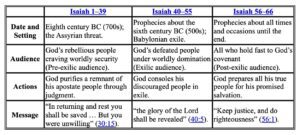
At 66 chapters, Isaiah is a substantial text, so it helps to understand that it can be treated in three broad sections, each corresponding to a particular audience and era. The table below, drawn (and slightly amended) from the ESV Study Bible, offers a helpful overview. The takeaway is that to understand Isaiah rightly, it helps to know which audience is being addressed at any given time.
The Narrative Key: Chapters 36–39
Isaiah 36–39 provides both the narrative key and the structural pivot for the book. Barry Webb’s commentary (Bible Speaks Today series) is excellent on this point.
Chapters 36–37 describe Sennacherib’s invasion and its outcome, resolving the Assyrian crisis which dominates Isa 1–35.
Chapters 38–39 deal with Hezekiah’s illness and subsequent reception of envoys from Marduk-Baladan, thus anticipating the Babylonian crisis, which casts its shadow over the second half Isaiah. Initially, Hezekiah, unlike Ahaz (Isa 7–8), appears to be the king that Judah and Israel had been waiting for to save the people, but he too ultimately falls short. The reader is left wondering who will be the king to truly restore Israel to glory. Chapters 40–55 begin to answer that question by revealing the Lord’s “Servant”.
The Key Theme: The Fate of Zion
The fate of Zion/Jerusalem is arguably the key theme of Isaiah, bookending the entire work (1:21; 66:20). In Isaiah’s early chapters, Zion falls under judgment but will be delivered to become a city of justice (Isa 1:8, 21, 26–27). By chapter 66, restored Jerusalem is God’s international city, welcoming people from the nations (66:20–21). This transition from judgment to restoration is hinted at in other parts of Isaiah (for e.g., Isa 25:6–9; 44:26–28).
Exhibit A: King Ahaz
King Ahaz stands as Exhibit A concerning the nature of Isaiah’s ministry. Isaiah’s prophecy about the virgin (or young woman) who will conceive (Isa 7:13–17) is spoken in judgment of Ahaz’s lack of faith and is incomprehensible to him. This is just as God told Isaiah it would be: “Go and tell this people: ‘Be ever hearing, but never understanding; be ever seeing, but never perceiving … until the city lies in ruins’” (Isa 6:9, 11). So it will be throughout much of Isaiah’s ministry until exile inevitably comes.
Concerning the prophecy itself, it seems to me that the virgin/young woman is best understood as Israel, who conceives and ultimately gives birth to a remnant named Immanuel—“God with us”. That is, the LORD will be with his remnant, birthed within Israel, who stand apart from unfaithful Israel. The remnant is embodied by Isaiah who takes God at his word and continues to hope in him while unfaithful Israel is embodied by Ahaz who refuses to take God at his word. Later, Isaiah’s virgin prophecy is cited by Matthew in relation to the birth of Jesus (Matt 1:22–23). What is often missed by Gospel readers, however, is that the prophecy in its original context is one of judgment. Matthew’s point in citing Isaiah will be played out throughout his narrative. “God with us” will prove to be good news of salvation for the humble but judgment and condemnation for the proud and self-serving.
Two Surprises in Isaiah 26
In Isaiah 26, we have hints that the understanding of Zion/Israel is shifting in the direction of something less “ethnic” and more international. Renewed/restored Jerusalem is described with open gates so “that the righteous nation might enter” (26:2)—those who trust the LORD, “the Rock eternal” (26:4). We also have a surprisingly rare occurrence in Old Testament literature—a hint of what might be described as resurrection faith:
But your dead will live, LORD;
their bodies will rise—
let those who dwell in the dust
wake up and shout for joy—
your dew is like the dew of the morning
the earth will give birth to her dead. (Isaiah 26:19)
The Servant of the LORD
The Servant is the key figure in chapters 40–55, highlighted by four “Servant Songs” (Isa 42:1–9; 49:1–6; 50:4–9; 52:13–53:12). No one song by itself gives a complete picture of the Servant. Each song, however, provides a new layer and everything becomes clear when all the layers are seen together.
By the end of the fourth song, we can say the following about the Servant: he is empowered by God’s Spirit to bring justice to the nations (42:1); he is humble and compassionate (42:2–3); he is a prophet (“Listen…” 49:1) commissioned to bring Israel and the nations to repentance (49:5–6); he is obedient even in the face of abuse (50:4–8); he will be rejected by his people even as he bears their sins, but in so doing will bring peace between the LORD and his people (53:3ff); he will “see the light of life” (resurrection glory?) and justify many (53:11).
Isaiah in the New Testament
Lastly, in relation to the use of Isaiah in the New Testament, it is instructive to begin by considering the Apostle Paul’s use of Isaiah concerning his own ministry. Paul and Barnabas’s preaching is rejected by the Jewish leaders in Pisidian Antioch (Acts 13:44–45). In response, they quote from Isaiah’s second servant song:
We had to speak the word of God to you first. Since you reject it and do not consider yourselves worthy of eternal life, we now turn to the Gentiles. For this is what the Lord has commanded us:
“I have made you a light for the Gentiles,
that you may bring salvation to the ends of the earth.” (Acts 13:46–47)
In this way, Paul and Barnabas present themselves as part of “restored Israel”—that is, as servants under the lordship of the chief Servant—carrying on his mission to be a light to the nations.
Recommended Reading
Abernethy, Andrew T. Discovering Isaiah: Content, Interpretation, Reception. Discovering Biblical Texts. SPCK, 2021.
Motyer, J. Alec. Isaiah, Tyndale Old Testament Commentaries 20, IVP Academic.
Watts Rikk E. ‘Isaiah in the New Testament’ in Firth & Williamson (eds), Interpreting Isaiah: Issues and Approaches, pp. 213–33. IVP Academic, 2009.
Webb, Barry G. The Message of Isaiah: On Eagles Wings. Revised ed. Bible Speaks Today. Inter-Varsity Press, 2023.