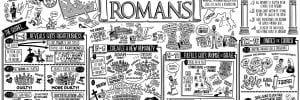


Brian Rosner’s Strengthened by the Gospel is the latest in Crossway’s New Testament Themes series which aims to provide an overview of each book of the New Testament. The books particularly concentrate on Biblical Theological themes.
Genuinely Fresh
Commentaries on Romans often begin with a short justification as to why the author thinks we need yet another commentary on Romans. Rosner does not need to justify his contribution, as his volume is a genuinely fresh approach to the letter. His book is not a commentary, and it does not cover every detail, but it gives readers a comprehensive overview of the letter. For preachers and bible study leaders, this kind of theological overview can often be as helpful as a commentary which is stronger at the detailed, exegetical level. This volume will be helpful for any reader who wants to grow in their knowledge of Romans.
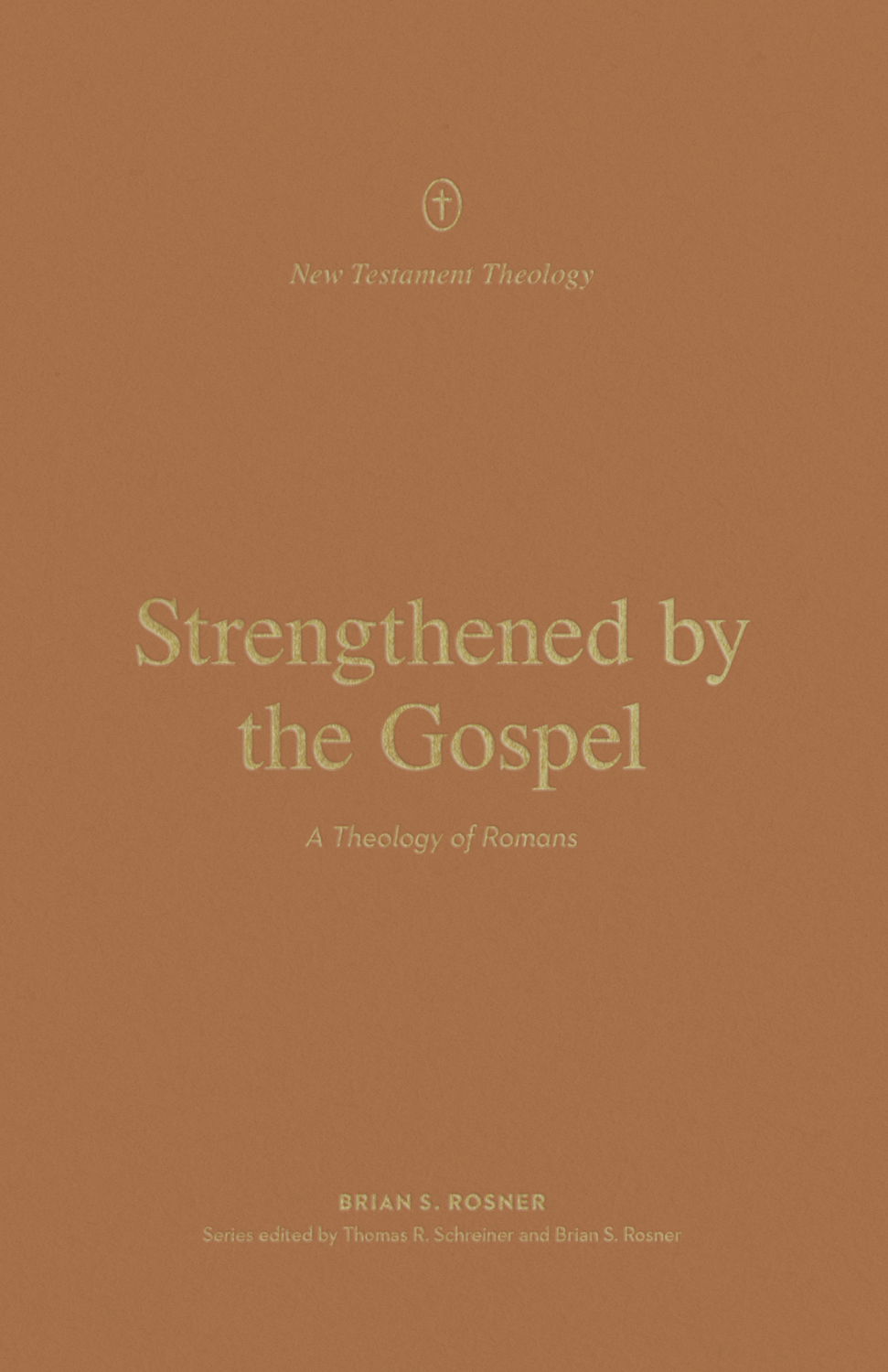
Strengthened by the Gospel
Brian Rosner
In this volume of the New Testament Theology series, Brian S. Rosner explores the key theology and themes of Romans, including sin, righteousness, justification, judgment, union with Christ, Christian conduct, hope, and more. By examining the letter’s Old Testament connections and the full scope of Paul’s gospel, this volume seeks to strengthen and encourage today’s disciples of Jesus.
Scholarly Current
One of the issues facing someone interested in studying Romans is that it is impossible to keep up with the latest scholarly literature. Rosner manages to summarize many important debates in a way that is accessible and comprehensive without drowning the reader in detail. Important questions (e.g. does Paul teach the imputation of Christ’s righteousness; does he speak of Christ himself exercising faith?) are covered in enough detail to help the reader navigate the issues. As such, the reader is orientated to the latest Romans scholarship in a very helpful way.
Romans Through Biblical Theology
Rosner examines Paul’s letter to the Romans through a number of Biblical Theological lenses: Universal Human Guilt (Chapter 2); Universal Human Bondage (Chapter 3); The Gospel of God’s Saving Righteousness (Chapter 4); Responding to the Gospel (Chapter 5); The Gospel and the Old Testament (Chapter 6); The Person and Work of Christ (Chapter 7); The Benefits of the Grace of God in the Gospel (Chapter 8); The Person and Work of the Holy Spirit (Chapter 9); Israel’s Rejection of the Gospel (Chapter 10); The Gospel and the Christian Life (Chapter 11); The Gospel and Life Together (Chapter 12); Gospel Living in the World (Chapter 13); The Gospel and the End of All Things (Chapter 14).
The Purpose of Romans?
A key issue related to the study of Romans is working out Paul’s purpose for writing. Why did Paul write such a long letter to a church that he had not founded and that he had never even visited? Rosner provides a very helpful discussion of the purpose of the letter. In the end he argues for a multi-dimensional purpose: the letter has missionary, apologetic, and pastoral purposes. The missionary purpose is seen in his desire to go to Spain to preach the gospel by way of Rome (Romans 15:23–24). The apologetic purpose is seen in how he defends both his person and his message throughout the letter.
The pastoral purpose is much easier to overlook. Rosner appeals to the letters framing to highlight the pastoral purpose. At the beginning of the letter, Paul expresses his desire to come to them (Romans 1:11–15) “to impart a spiritual gift to them, to experience mutual encouragement, to reap a harvest among them, and to preach the gospel to them” (p. 4). Rosner takes each of these phrases as related to the preaching of the gospel – the “spiritual gift” is the gospel. Paul is confident that the Romans will be strengthened by the impartation of this gift. This idea of the gift as the gospel also comes out at the end of the letter. In 16:25, Paul expresses the wish that God would strengthen them “according to my gospel and the preaching of Jesus Christ” (16:25). As such, Rosner argues that Paul wrote “to strengthen his readers with a full presentation of his gospel” (p. 8). Importantly this pastoral purpose is not tied simply to the issue of unity i.e. the pastoral dimension is not exhausted by the matters he deals with in chapters 14 and 15. His pastoral concern for the Roman church is broader than that.
Pastoral Applications
Rosner returns to Paul’s pastoral concern at the end of Romans, where, in the epilogue, he considers 16:25 as a key verse for the letter as a whole: “To him who is able to strengthen you according to my gospel.” He notes,
God not only justifies, redeems, and reconciles us through the gospel but also gives us the strength we need for the Christian life through the gospel. Only the gospel gives us a clear-sighted view of our fleshly existence, our moral incapacity and weakness, and the means of dealing with our guilt and shame. Only the gospel sets us free from sin’s power when we present ourselves to God as those who have been brought from death to life in union with Christ. Only the gospel enables us to cast off the works of darkness by putting on the Lord Jesus Christ. Only the gospel gives us a mind set on the Spirit which is life and peace. (p. 191)
The paragraph continues, but this quote gives a flavour of the pastoral application that flows from not only the letter but also Rosner’s book.
Old Testament Helps
I could summarise each chapter but the one on Paul’s use of the Old Testament was particularly helpful. Rosner notes that the “use of Scripture in Romans is not another volume in the Romans theological encyclopedia as much as the shelf on which all the other volumes sit” (p. 88). This is so helpful. All too often we think of the Old Testament as simply providing the prophetic proof of what the New Testament writer is saying. And if that is the case, why would we spend time studying the Old Testament? We know that it is true! But Brian shows us that for Paul the Old Testament has a much richer and more profound role – the Old Testament actually helps us understand the Gospel.
Strengthened by the Gospel is a very helpful book on a critically important letter in the New Testament. Christians always need to be grounded in and strengthened by the gospel. This book will open new vistas in a familiar letter and in so doing will, I am sure, reap a spiritual harvest amongst its readers.