


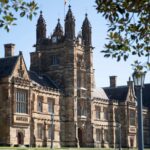
St Mark’s Darling Point Anglican Church is a building of singular beauty, standing in one of the most beautiful harbourside suburbs of Sydney. It has its place in Sydney’s lore as the church of some of Sydney’s best-known families, and as the place where some famous (fictional and real!) weddings have taken place. That is to say, it is a property of civic and historic, as well as spiritual, significance.
However, these realities may distract us from the deeper theological principles of owning property. If we had less attractive and less historic buildings, we might be more inclined to consider why we own them. Why would anyone not want to own the properties of St Mark’s Darling Point?
God’s Ownership Relativises Human Ownership
To consider why we own property, we must start with the Triune God, and with God’s purposes in the world. Psalm 24:1 says: “The earth is the Lord’s, and everything in it.” He is the creator of all things (Gen 1; Ps 104), which means there is nothing that does not belong to him. In the New Testament we hear that the creation was made by and through and for the Son of God Jesus Christ (Jn 1:1-3; Col 1:15–20). All creation ultimately points to him.
Human beings were created by God for the purposes of bringing the creation to its fulfilment, to the honour and glory of God’s name (Gen 1:26–28). Made in his image, they are called to rule the creation in his name (see Ps 8). Here we learn something about God’s determination to invite human beings to share in his purposes for the creation. They are part of the creation—and so embodied creatures—but they are also God’s agents in the creation. ‘Stewardship’ describes this original human vocation very well: it is responsible care for that which belongs only temporarily to us, but ultimately to God.
God’s ownership relativises human ownership. The world was not given to Adam and Eve as theirs, but as their responsibility. They are answerable to the creator for their governorship of the world. The same is true of Israel’s relationship to the land: Israel is given the land on trust (“The land is mine”, the LORD says in Lev 25:23). Their occupation is provisional, it depends on their relationship with God. The question for human ownership is, then, what does the Owner want done with the things he has entrusted to us?
In this sense, Christian ‘ownership’ is always penultimate. We may possess property legally and responsibly, but we never possess it absolutely. What we own is ultimately God’s, and therefore our possession entails responsibility rather than unrestricted entitlement.
The Church of God and the Mission of God
The mission of God is to redeem and restore all things in Jesus Christ (Col 1:15–23). By his death and resurrection, Jesus has established a new people of God, creating a new humanity from the old. He calls to himself people of every tribe and tongue, male and female, young and old, slave and free, giving them a remarkable grounds for unity in diversity (Gal 3:28). Through that ekklesia (‘gathering’) in the name of Father, Son, and Spirit, God chooses to continue his mission to restore and redeem the whole creation, to the glory of his name.
The local gathered church exists, then, as a chosen people, a holy nation, and a royal priesthood, so as they may “declare the praises of the one who called them out of darkness into his marvellous light” (1 Peter 2:9). They gather to praise the Lord, for mutual edification (1 Cor 12–14), to dedicate themselves to the apostles’ teaching, and to break bread in fellowship (Acts 2). They are sent out to be salt and light to the world, to make disciples of all nations (Matt 28:16–20), to announce the good news, and are ready to “give a reason for the hope that is in [them]” (1 Pet 3:15–17). Another way of putting this is: the church exists to worship God and to make and to grow disciples of Jesus Christ.
In its gathering, the local church anticipates the eschatological gathering of all of Christ’s people around the heavenly throne (Heb 12:22–24). It lives according to the Lord whose “kingdom is not from this world” (Jn 18:6), but it does so as human beings who still inhabit this world as embodied creatures. It is called to practice love of one another as a sign of its belonging to the crucified and risen Lord.
The Mission of God and Church Property
Because of these realities, the church meets habitually, regularly, and in person (Heb 10:25). A church need not have properties dedicated for this purpose, but where it has the opportunity to own properties, they should exist to encourage and enhance the habitual, regular, and in-person meeting of God’s people for the purposes of hearing from the word of God, mutual edification, prayer and praise, the breaking of bread, and the visible expression of our unity in diversity.
Church property should also enable the church to practise the biblical virtue of hospitality: to make room for the stranger, the neighbour and those who might otherwise have nowhere to belong (Rom 12:13; 1 Pet 4:9). A Christian property is not merely space that the church occupies, but space that the church makes available to God and neighbour, welcoming them in the name of Jesus Christ so that they might know him and receive his grace.
Our property stewardship is never merely for the benefit of the institution that possesses it. Scripture repeatedly enjoins God’s people to consider the neighbour, the poor, and the stranger in the use of the things God has entrusted to them. Our property may be a means by which we can “do good to all, especially the household of faith” (Gal 6:10). For example, a church may consider using its property to make accessible housing available to those who need it.
Church Property and the Future
The church also is called to watch (Matt 25:1–13), for the time is short (1 Cor 7). We do not know the day or the hour of Christ’s return, but we know that the old order of things is passing away (Rev 21:1–5). The earthly institutional trappings of the church—like buildings—which are needed for living today, are temporary necessities. Our stewardship is not primarily of our buildings but of the gospel of the Lord Jesus Christ, a stewardship that is enabled, in part, by our buildings. The church doesn’t exist to preserve its buildings; its buildings exist to serve the church’s calling.
The Bible also warns us against allowing fear or indecision to govern our stewardship. Jesus’ parable of the talents is instructive: the servant, from fear, simply preserves the money entrusted to him rather than putting it to work (Matt 25:14–30). He fails, not because he acts without regard to risk, but because his fear leads him to do nothing at all. This is not a call to recklessness but a reminder that we have a responsibility to act faithfully and wisely to serve God’s purposes with the things he has entrusted to us. Wise management of risk is not the same as avoidance of risk.
We therefore have to weigh the urgent needs of the present day with the responsibility to make ministry easier for the next generation. We possess properties because people need to hear the gospel right now; and we possess them because people will still need the gospel in years to come.
Because property is a means rather than an end, faithful stewardship may sometimes require acquiring, retaining, adapting, sharing or disposing of property. There is no theological presumption that a church must retain a building simply because it has inherited or acquired it. The question is always how the resources entrusted to us can best serve the purposes of God.
Church Property and the Past
What are we to do with the cultural and historic significance of our buildings? This is not every church’s issue, but it is for many. We’re deeply embedded in the psyche of place, even for those who aren’t members of the church. We receive tax deductions for maintaining the heritage of our sites, and are held responsible for stewarding some of the nation’s historic structures and memorials. This can be a liability for Christian ministry, but also an asset, if our stewarding of our sites is seen as part of our care for our community and its places of significance and shared identity. By accidents of history, we’ve been given a treasured and trusted place in the community we seek to serve. We should seek to find ways to express our common care with our neighbours, while articulating what these buildings were built to signify.
It is also worth noting that many older church buildings are built on land taken illegitimately by the Crown from First Nations inhabitants. We benefit not just from the glorious but also from the darker chapters of the past. This is not to make a simplistic moral equation, or to demand that reparations be paid. Twenty-first-century Christians, however, should not evade this question; it should be a consideration when it comes to making use of or drawing profits from our properties. In St Mark’s case, support of local indigenous ministries has been a long-term commitment.
Our properties should serve and embody who we are in Jesus Christ. They may be beautiful, offering a glimpse of transcendence in a culture often dominated by utility and consumption, and reminding our community that there is more to life than the here-and-now. They embody Christian hospitality, making welcoming space for different kinds of people in the midst of a profoundly disconnected society. They turn us towards, rather than away from, one another. They enable us to share the gospel with our neighbours as salt and light. They enable us to be generous to the cause of the gospel in the city, the nation, and across the globe.
An earlier version of this article was originally posted on Michael’s Substack.
To support the ongoing work of the local team at The Gospel Coalition Australia, make a regular pledge or once-off donation here.