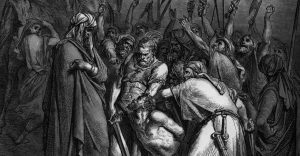





One of the interesting facts from early church history is that Christians were accused of being atheists.[1] They didn’t do the religious things that were expected by their contemporaries in the Roman world. That might be a surprise to many in the secular West, where Christians usually look obviously more religious than their secular neighbours. After all, Christians have faith, they pray, they attend worship services. Many go further by wearing crosses, carrying Bibles, fasting, and orientating their lives around priests, festivals, saints and pilgrimages.
As many of us witness an uptick in interest in religion, including Christianity, especially among young men, I wonder what these new inquirers are attracted to. Is it Jesus and his saving work? Or is it religion, with the trappings of symbols and rituals? Exploring why the early Christians were accused of being atheists could be a helpful exercise for us in this moment.
Why Christians Were Called Atheists

The early Christians didn’t build any buildings that could be identified as Christian. They had no temples or shrines or holy places. Instead, they met in homes, using the spaces and furniture of normal life. They had no images of their God to venerate, pray to, or adorn their homes or meeting places. The only images we have of Jesus from the early centuries were drawn by mockers, not Christians.
The early Christians had no priests wearing sacral garments and offering to secure favour and prosperity if you paid the right price. They made no sacrifices of animals, food, money or possessions to their God. They certainly did not participate in the ubiquitous worship of all the other ‘gods’ of the Roman Empire. That is why their contemporaries called them atheists.
How Christians Talked About Themselves
The suspicion they were atheists, not religious, was likely enhanced by the language they choose to use about themselves and their practices. This aspect of early Christianity is not easy for us to tune into, because the English equivalents of these words are now Christian terms that carry a distinctly religious connotation.
So ‘church’ is an exclusively religious word for us. But the word translated church, that Christians commonly used for their meetings (following Jesus—Matt 16:18, 18:17), was a non-religious word. It was used of both formal and informal gatherings. You can see this secular usage in Acts 19:32 and 19:39, where English translations usually translate this word as ‘assembly’.
The words the early Christians used for church leaders were likewise common words used of leaders in non-religious contexts: elder, overseer and deacon. Christians used the word ‘fellowship’ to describe their relationship with God and each other. This was a word derived from and most often used of business partnerships. Even ‘gospel’ was a media word in the worlds of both the Old Testament and the New Testament, used to describe any momentous news, especially the rise and fall of empires and emperors.
The words used to describe praying were normal, everyday words for asking. Even the English word ‘pray’ simply meant ‘ask’ when the Bible was translated into Elizabethan English. You may have heard people speak in the English of those times saying, ‘Pass the salt, I pray thee.’
Although we use the word ‘faith’ almost exclusively of the religious sphere today, in the Roman world was used much more widely of the trustworthiness of people.
Worship language, used in that culture for temple rituals, was not used by the New Testament writers to describe such cultic activities, but to describe the everyday life of obedience to God and evangelism (for e.g. Rom 12:1 and 15:16).
The word group ‘religion’/‘religious’ (Gk thrēskeia/thrēskos) is used in James 1:26–27 of Christian behaviour, but James’ description subverts what might be expected as religious activities. To be religious, according to James, is to keep a tight rein on our tongues, to look after orphans and widows, and keep oneself from being polluted by the world.
Some of these terms and concepts were used by first-century Jews in connection with their religious practices, but Jews were also seen as weird by most non-Jews. Christian spirituality, and to a large extent Christian vocabulary, was not ‘religious’ as their contemporaries understood it.
Christian Spiritual Reality
Why did the early Christians pervasively undermine so much of what their Roman neighbours would have considered ‘religious’? The central answer is Jesus. He has fulfilled all the religious categories that existed in the Old Testament. He is our perfect High Priest, who offered the once-for-all complete sacrifice to cleanse our consciences, offering himself to the Father in the heavenly tabernacle. He continues to be our perfect High Priest, interceding for us so that we are able to draw near to God confidently (a summary of Heb 7–10). God, by his Spirit, indwells us, so that we (individually and corporately) are his temple (1 Cor 3:16, 6:19).
All this means that we are welcomed into a real, personal relationship with God. The Bible speaks of knowing Christ and knowing God (Php 3:8; 1 Jn 2:3); and of being born or adopted into God’s family (1 Jn 3:9; Eph 1:5). Personal relationship is a different category to religion, because religion (in the world of early Christianity) was fundamentally transactional, whereas personal relationship is built on forgiveness, trust and love.
The language used by the early Christians reflects this wonderful reality. It is the language of personal relationship, not religious language. It expresses the reality of being welcomed into God’s family by his remarkable mercy to us, not by any religious activities we perform. It reflects the truth of the Christian gospel. What we often classify as the spiritual realm has become for Christians a relational realm—we know God and are known by God. It is not a mysterious grasping for something spiritual.
It seems many are looking for spiritual things today, and are attracted to traditional religious practices and structures with their mystical and aesthetic appeal. But Christ offers them something far better than spooky mystery and ancient religious practices. He offers life through his death and resurrection. He offers eternal life—for ever knowing the only true God, and Jesus Christ, whom he sent (Jn 17:3). We may look unreligious to some, but we have been given something that no religious person has.
[1] See for e.g. Justin Martyr, First Apology (c. 155–157 AD).
The insert photo is by Heretiq – Own work, CC BY-SA 2.5.