




Mikey Lynch recently published an article for TGCA encouraging youth ministries to display both social activities and teaching topics on their term calendars, and I’m grateful he did. It’s a simple, practical and easily applied set of suggestions, which I can see being immediately useful to a number of contexts. Plus, Mikey wasn’t grumpy or despairing at youth ministries, nor is he belittling or condescending in his proposals. As a youth minister, I was encouraged.
However, when he asked me for my thoughts, I did find myself wanting to nuance (or even push back on) something in his initial premise. So, after a friendly exchange of emails, he invited me to pull together some thoughts.
Balancing Act of Faith and Fun?
Mikey’s introduction frames youth ministry as a ‘timeless balancing act’ between ‘the faith (Bible, prayer, singing) and the fun (including food, friendship, games)’. In doing so, he rightly affirms ‘the Bible truth that God made us with bodies and minds’ and writes that ‘“fun” provides many opportunities to model Christian community’. But I’m always nervous about how the conversation develops around ‘faith vs fun’, because it’s behind the most common ministry mistake I see as I train others in ministry amongst young people.
Mikey and I agree about the dangerously gnostic division of the spiritual and the physical. I just fear that framing youth ministry as a ‘balancing act’ between them concedes the very division he warns against. For example, he could do more to mention both the spiritual nature of food and community, and the deeply enjoyable nature of engaging big ideas in good discussions (although I was pleased to see him quote from Hayden Griffiths in a footnote, making this same point!).
Just to be clear: I’m all in favour of Mikey’s suggestions and conclusion, as I’m a big fan of any step that helps youth groups turn up the spiritual temperature in their ministry. But as I read the article with my youth ministry hat on, my fear was that by trying to encourage ‘balance’, Mikey might have inadvertently relegated faith and fun to opposite ends of the scales.
Using the Wrong Scales?
Maybe imagining a different type of scales could help us. When we talk of balance, we tend to imagine the sophisticated-see-saw kind of scales, designed to keep things at either end level with one another. Then, there’s the bathroom scales. One platform, simply aimed to tell us – ‘how much does this weigh’? And I wonder if this might be a better way to conceptualise the way we combine fun and faith in our ministry with young people.
The more time I spend with Christian and non-Christian teenagers, the more I’m head over heels convinced by a simple realisation: these kids aren’t bored. They’re hungry. And the questions they face every day are heavy ones.
As a result, they’re not wanting me to balance the scales between fun and faith. They genuinely find the weightiest stuff we have to offer the most engaging, whether that’s in their experience of community, or the ideas we deal with together. As we’ve started leaning into that, I’ve been constantly amazed by what happens when we raise the bar on depth and discipleship too: they just jump higher.
So if I had to offer a constructive counter-proposal to Mikey’s article, it would simply be this: what if we aimed even higher than inclusion of our teaching content on our flyers. Why not make the teaching content the main thing? Or… the only thing? What if that was actually more attractive to young people anyway?
Our Anecdotal Evidence
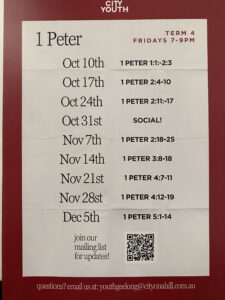 Here is the Canva flyer we used for Term 4 last year. Not only did we break all the rules about what should go on a youth ministry flyer, but it worked. Each week of the term was thirty minutes of social time, and ninety minutes of content (in a sermon plus small groups). More, our year 11s were the ones who preached the series (after a term of training with me). They did a great job, and put heaps of work into crafting faithful expositions. I was bewildered to discover that our youth ministry grew that term, from a group of about 65 to about 100.
I’m not arguing that the flyer made our group grow, or even that it helped. It certainly wasn’t an intentional marketing strategy on our part, nor are my Canva skills evidence for the existence of God. But after using that as our flyer last term, I am more convinced than ever that the fun stuff on our previous communication had very little to do with why young people were coming along, or what they were hoping for in the first place.
Enjoyment Is Bigger than Fun
I really liked Hayden’s point in the footnote of Mikey’s article:
what youth (and people more broadly) crave most is relationships … the way we do all the other things (reading the Bible, praying, singing, small groups) can be done in ways that are enjoyable or not enjoyable, without ever needing to ask whether they’re ‘fun.’
‘Relationship’ seems like a great example of the ‘diagonalization’ Chris Watkin encourages to get us beyond simplistic false dichotomies. And where relationships are strong, regardless of the size of the group, faith and fun flourish, and a youth ministry grows in its gravitas.
When I recruit new leaders to our team, I try to describe what we’re aiming for with an analogy. From about the age of thirteen, the best part of every party stops being the planned activities, the food, or even the high energy celebrations. Pass the Parcel only appears at a fifteenth birthday ironically. Instead, the best part is the moment when things have started to die down. There’s only a few people left around the campfire, gazing up at the stars, sharing big thoughts and big questions. They laugh. They sit in silence. They think deep thoughts.
Is that ‘fun’? Absolutely. Everyone in that circle shares a sense of how enjoyable that moment is. But they also know it’s so much more than that. It’s weighty. And that’s the tone we’re trying to set as often as possible in our youth ministry.
I’m still working out how we communicate this via Canva. And if mentioning content in your communications is a step in the right direction for your youth ministry, then you should take Mikey’s advice and run with it.