




The timeless balancing act of youth ministry is that of balancing the faith (Bible, prayer, singing) and the fun (including food, friendship, games). If we’re honest with ourselves even mature adult disciples engage with church and ministry programs for a mixture of reasons—how much more should we expect high schoolers to be drawn to youth ministry for both its deep spiritual content and its games, snacks and social opportunities. It is also true that what I’ve called ‘fun’ provides many opportunities to model Christian community to the non-Christian and Chrisitan kids at youth group.[1] To be super-spiritually Bible-and-prayer-only in your approach to youth ministry is actually to be unspiritual, for it is to deny the Bible truth that God made us with bodies and minds that mature slowly over years and years. Still, you don’t want to water down the discipleship input of youth group. It is, after all, a church youth group not a social club. A place where is this timeless balancing act can be seen at the moment is in the trend of the Canva term calendar.
The Graphical Term Calendar
As graphic design has become more accessible through sites like Canva and design software with built-in templates, it is increasingly common for youth ministries to publish a nicely designed term calendars with dates, times and other information.
What has accompanied these graphical calendars has also been a rise in the publishing of specific activities for each week (or fortnight or month) of the term: dessert night, movie night, silent disco, combined inter-church youth night, fancy dress, scavenger hunt and so on. This forward planning and promotion makes sense on many levels. Batch-planning relieves the team of a weekly mental load. The gimmick of different themes adds a little extra appeal to motivate the youth to attend, with different teenagers drawn more to this or that week. Publishing the activities in the calendar also helps with promoting youth group to newcomers, including non-Christians.
What’s On? Why Go?
There is, however, a little risk with these great-looking term calendars full of interesting stuff: what do they say about what youth group is all about? What do they say about why it’s worth coming along? Even if the calendar has a slogan or blurb about the group’s gospel purpose, this can easily be outshone by goofy fonts and images of popcorn, frisbees and playing cards. It’s possible that the vibe term calendars send out to high schoolers, parents and perhaps even team leaders is that the big thing about youth group is the fun and the food and the friendship. That’s what’s on. That’s why you go. Our advertising can fail at the timeless balancing act of faith and fun.
Both–And
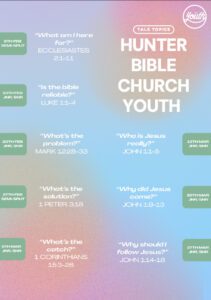
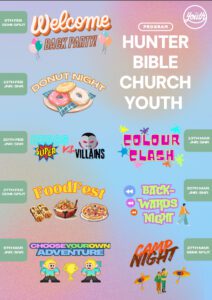 There’s an easy fix, of course: find clean visual ways to communicate both the range of fun gimmicks planned for the term and to list the range of rich topics that will be explored in the teaching program.
What’s On at youth? Both board games and ‘Why does God allow suffering?’; both a picnic at the dam and Q&A with the youth leaders and the senior pastor.
Why go to youth? Because of the interesting and fun activities (that provide enjoyment in a wholesome and spiritual way and the experience of peer-to-peer and youth-to-mentor relationships in a Christlike community) and for the deep and relateable teaching from God’s word and opportunities to sing and pray and talk about following Jesus. Here’s an example from Hunter Bible Church, Newcastle.
[1] In an email exchange, Hayden Griffiths from Providence Church suggested the larger category of ‘relationships’ to capture a whole range of things we do in youth ministry; and a broader qualitative measure of ‘enjoyable’:
what youth (and people more broadly) crave most is relationships … the way we do all the other things (reading the Bible, praying, singing, small groups) can be done in ways that are enjoyable or not enjoyable, without ever needing to ask whether they’re ‘fun.’