
How should Christians live wisely and remain faithful to Christ in a society where religious freedom is on the wane? This is the question driving Patrick Parkinson’s new book, Unshaken Allegiance: Living wisely as Christians with diminishing religious freedoms.
Parkinson writes not as a theologian or a pastor but as a Christian legal academic, and as someone who has experienced intense religious restriction first-hand through his time in communist Czechoslovakia in the early 1980s. An Emeritus Professor of Law and former Dean of Law at the University of Queensland, Parkinson brings a legal lens to help Christians think wisely about living in a changing cultural and legal landscape.
As Parkinson states from the outset, this book “is about how we live as good citizens of our countries but with an allegiance to another King—a King whose demands must, in certain situations, take precedence over the requirements of the law” (p. 13). This two-kingdoms framework shapes the book. Christians genuinely belong to earthly nations and should seek to be good citizens within them, but their deepest loyalty is to Christ, whose kingdom relativises every earthly authority.
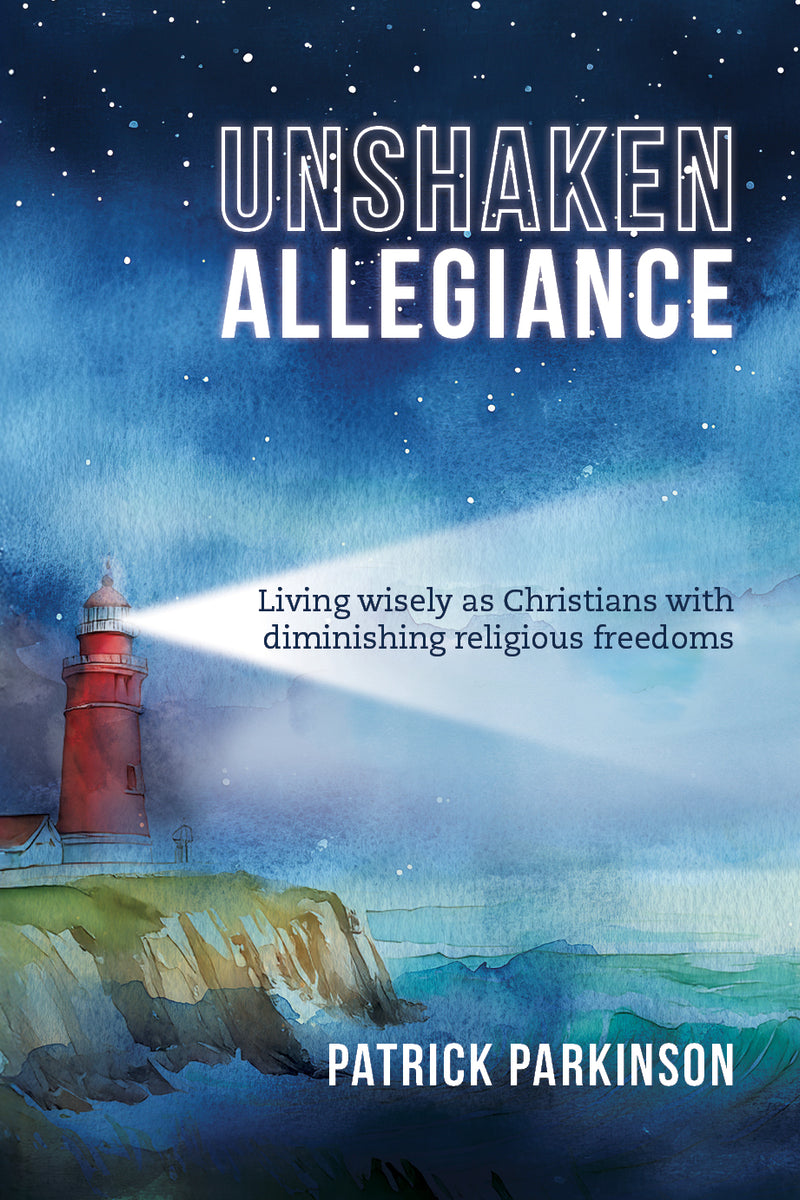
Unshaken Allegiance
Patrick Parkinson
In Unshaken Allegiance, Parkinson combines a sharp theological mind with his vast understanding of the law, offering a guide that will help every Christian navigate the legal and spiritual minefield that lies before us. Filled with case studies and biblical insights, driven by a passion for both the law and the gospel, this is an indispensable resource for every Christian.
Parkinson’s book “is intended as a practical book, written especially for pastors and other leaders of churches or Christian organisations, as well as for everyone interested in what it means to be citizens both of an earthly nation and of Jesus’ kingdom at a time when the tide of religious freedom is receding” (p. 15). This makes at accessible to a wide audience, though it will probably be of most interest to readers from Australia, New Zealand, and the UK.
Parkinson’s Three Movements
Parkinson’s book unfolds in three clear movements. Rather than rushing straight into advice, he first helps the reader understand the broader landscape, then reflects on how Christian faith relates to law, and only then turns to concrete ministry situations. So, it moves from diagnosis, to principle, to practice.
Part 1: Understanding the Problem
The opening section maps the cultural and legal shifts that have brought Christians to the present moment. Parkinson asserts that “as the tide of religious faith is going out, so too the tide of religious freedom is going out” (p. 24). These early chapters tease out what’s changed, why it’s changed, and why religious freedom now feels more fragile than it once did.
Part 2: Law and Faith
Having set out the problem, Parkinson then asks how Christians should think about the relationship between obedience to God and government. According to the Scriptures, government “is given to us by God and has authority from God” (p. 125), but the “authority of earthly rulers is subsidiary to the authority of God” (p. 136). This middle section does the book’s most important conceptual heavy lifting. It slows the discussion down to ensure we avoid two mistakes: blind submission on the one hand, and reactionary panic on the other.
Part 3: When Law Comes into Conflict with Ministry
Having laid the groundwork, Parkinson turns to practice. This final section asks what happens when legal requirements and Christian ministry collide. How do we avoid unnecessary legal trouble? How do we decide when not to comply with the law? When is a legal defence the right response? And can mutual tolerance survive in a society that no longer shares Christian assumptions? Parkinson calls us to “pick our battles carefully and to engage in such debates with wisdom and grace. Fighting every battle with similar intensity and effort may seem heroic, but it is not how generals win war” (p. 178).
What I Liked
There were several things I appreciated about this book, not the least of which was, firstly, the book’s simplicity. My legal knowledge is pretty much limited to a first-year Business Law subject taken nearly 20 years ago, but Parkinson’s style made the book accessible to a punter like myself. As one of the commendations at the start of book mentions, “there are skilled ways to put important things in language that’s accessible. That is exactly what Patrick Parkinson has done in this book” (p. 4). Each chapter begins with a poignant question, which Parkinson simply but compellingly addresses.
Second, I appreciated Parkinson’s use of vivid, real-world examples to illustrate abstract legal concepts. Whether it was the “permanently red traffic light” in Chechnya as a metaphor for arbitrary power (p. 22) or the “lawfare” faced by Archbishop Julian Porteous and Dr Bernard Randall (p. 66ff), these stories make the legal threats feel both concrete and relatable.
Third, I found the distinction drawn from Rawls between “civil disobedience” and “quiet non-compliance” particularly helpful (p. 144–146). Civil disobedience is a public, deliberate, non-violent breach of the law meant to protest injustice and bring about legal change. It usually includes a willingness to accept the penalty. Quiet non-compliance, on the other hand, is a more discreet refusal to obey a particular law because conscience will not allow it, often so that Christians can continue living faithfully or carrying on ministry without drawing unnecessary attention. Sometimes a public stand is needed. Sometimes, quieter resistance better serves faithfulness and gospel ministry. Parkinson’s point is that Christians need wisdom to decide which path fits the situation.
Fourth, I appreciated the effort taken to be a non-anxious presence at the table. Discussions of religious freedom can often feel panic-infused. Parkinson’s prose mostly avoids this. I found chapter 8 particularly helpful to this end. Drawing on the Scriptures, Parkinson calls on Christians to live peacefully (1 Tim 2:1–3), pick their battles (2 Tim 2:23–24), keep calm and carry on giving a Christ-like witness (1 Pet 3:15) while seeking to avoid “poking the bear”! It’s easy for Christians to either retreat from the public square, or to live in a state of panic-driven combat. Parkinson charts a course that avoids both extremes— blind submission on the one hand, and reactionary panic on the other.
My Big Question
My only (petty) complaint is that the book often uses Americanised spellings — “organization” rather than “organisation”, for example.
The book did, however, raise one bigger question for me. It is not quite a critique, at least not yet, but it did leave me wondering whether Parkinson’s framing is broad enough.
Central to the book’s purpose is the claim that religious freedoms are diminishing in the West. It’s in the title. That claim is not hard to understand. If I had read this book in 2017, during the height of the same-sex marriage postal vote debate, I doubt I would have hesitated over it. At that moment, it felt obvious that the cultural and legal tide was moving in one direction, and that Christians needed to prepare for a future of shrinking freedom.
Parkinson’s case studies show that this concern is not imaginary. Some of the recent examples he discusses are genuinely sobering, and they make a strong case that Christians, churches, schools, and organisations need to think much more carefully about law, conscience, and ministry.
Even so, I found myself wondering whether the broader picture is now a little more unsettled than the book’s framing often suggests. The issue is not whether religious freedom is under pressure. Clearly, it is. The question is whether that pressure should be described as a simple, steady, and inevitable decline.
The political picture now feels more contested than it did ten years ago. In the United States, Trump’s 2025 executive orders on “anti-Christian bias,” the establishment of a White House Faith Office, and the creation of a Religious Liberty Commission all suggest a climate different from the one many assumed was inevitable a few years ago. Across the West, the rapid growth of populist and anti-establishment parties and movements has further complicated the picture, especially where those movements have pushed back against aspects of the progressive agenda. Even in Australia, there are smaller signs of this wider instability. Recently, we’ve seen One Nation’s resurgence, with recent polling placing its first-party-preferred vote above the Liberals’. More recently, they’ve even won a lower house seat.
Whatever one thinks of these movements—and there is plenty to be concerned about—their rise suggests that the story may be more complex than a straightforward march toward progressive secular consensus. Admittedly, Parkinson briefly acknowledges some of these trends. However, as I read through the book, I expected to encounter more interaction with this changing picture. I was surprised not to encounter more.
None of this overturns Parkinson’s overall argument. Christians must continue to think wisely about what unshaken allegiance to Christ looks like in a constantly changing world. My question is simply whether the decline of religious freedom is as linear, settled, or culturally inevitable as the book’s framing can sometimes imply. Perhaps things are not quite as bad as some Christians fear. Or perhaps the pressure is real, but the future remains more open than we sometimes assume.
Nevertheless, any real and lasting change will not happen by accident. If Christians are to live with unshaken allegiance to Christ in this changing landscape, we will need clear and careful thinking, and books like Parkinson’s to help us understand the moment.
So, you should read the book. Unshaken Allegiance is clear, calm, and practically useful. Even if one ends up qualifying part of Parkinson’s broader framing, the book succeeds in providing something many Christians need right now. It provides wisdom on how to live faithfully, while resisting both blind submission and reactionary panic.