

Dave Moore’s The Team Leader’s Handbook will equip team leaders to lead with conviction and confidence. As someone who has led and served on many teams in ministry contexts, Team Leader’s is a worthwhile read. It compiles various principles I’ve been taught over the years and lessons I’ve learned from experience, while also bringing fresh insights to team leadership.
Team Leading in Five Parts
Moore breaks his book into five sections. Part one talks broadly about the nature and value of team leading. This section also introduces the four conversations model which features prominently across the book. In part two Moore specifies what team leaders should always do, including prayer and culture setting. In part three he states what team leaders should regularly do, such as gathering for encouragement and giving feedback. Part four covers what team leaders should often do, like recruiting new members and record keeping. In part five Moore concludes by recommending three tools that he has personally found useful as a team leader. These tools help teams reflect on themselves, their season, and their performance, so that they keep serving well together in line with their purpose.
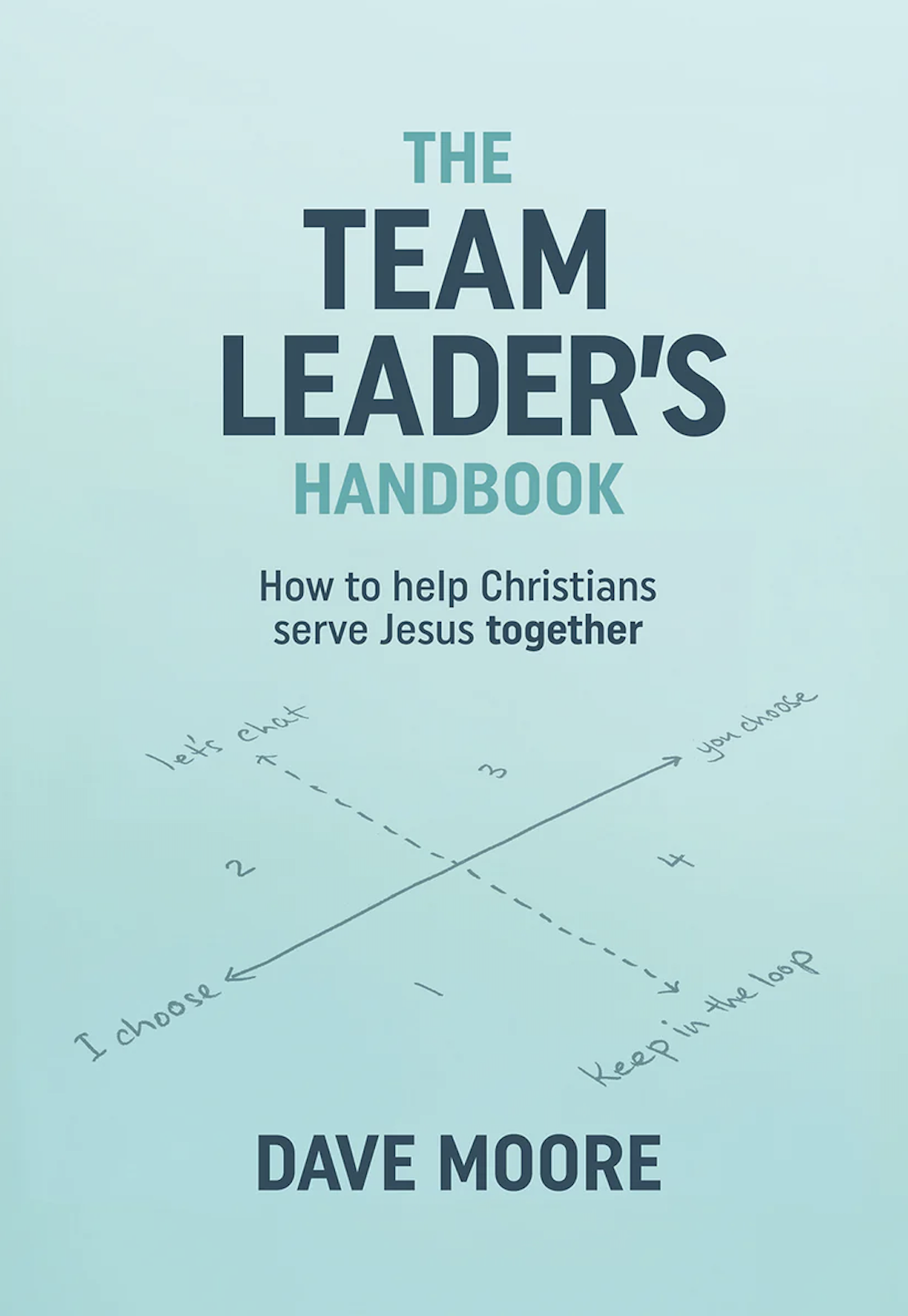
The Team Leader's Handbook
Dave Moore
For the Inexperienced
Team Leader’s is pitched at people who aren’t confident or experienced team leaders, particularly those who are just starting out in a new role. Moore gives words of comfort to those who feel intimidated, but he also gently pushes those who may be reticent to undertake leadership or those who need help to persevere with their role. He persuades his readers to see how necessary the team leader role is, and how joyful and satisfying it has the potential to be. Moore coaches team leaders in the mindset they must have, the character they must prioritise, and the tasks they must do, all while staying motivated by gospel. This is a great book! It’s easy to read, clear, well-structured, and casually written. There are stories, anecdotes and discussion questions throughout which assist the reader in prayerfulness and reflection.
Pearls of Wisdom
Team Leader’s is very comprehensive. The only downside to this comprehensiveness is that experienced team leaders might find the book slow-going. They may find themselves reading through familiar principles quickly in search of a fresh angle or for new ideas and strategies that they could try. Nonetheless, it certainly won’t do any leader harm to be reminded of things like the value of their team, the importance of godly character, and the necessity of gathering for meetings. There are numerous pearls of wisdom to be discovered.One such pearl is the previously mentioned four conversations model. This is Moore’s attempt at distilling all team leader conversations into four types: 1) Let me keep you in the loop about something I’m deciding; 2) Let’s chat about something I’m deciding; 3) Let’s chat about something you’re deciding; 4) Keep me in the loop about something you’re deciding. This model aims to bring clarity to both team leaders and members around decision making. Namely, who makes the final call and how collaborative the process will or won’t be. This is a handy framework for teams to be familiar with and gives teams a common language with which to frame their discussions.
Another pearl of wisdom is Moore’s encouragement for teams to have a “big prayer.” The big prayer is “a humble and exciting vision of what you’d love God to do in your team and through your team” (p. 55). Moore regards the big prayer as different from a team vision statement, wanting to focus first and foremost on getting the team praying. Even though his intention is not to provide a vision statement, I appreciate that it achieves both and that he pushes Christian teams to be regularly praying a big prayer to God, pleading for him to be at work.
A Weak Theological Justification
The weakest section of Team Leader’s is Moore’s theological justification for teams (p. 21-25). He gives numerous examples of teamwork in the Bible but in doing so seems to imply that they establish a biblical case for team-based ministry (as understood by our present ministry context here in Australia). Moore names Adam and Eve, Jesus’ disciples, and various groupings of workers in the New Testament to demonstrate that we are “not only God’s children; we’re part of his crew, part of his team” (p. 23). He also appeals to 1 Corinthians 12 and our mutual interdependence in the body of Christ to support his argument. Moore isn’t wrong to say that these are examples of teamwork, but to link them to a particular conception of team-based ministry is confusing, and possibly dangerous. Should we serve together as part of the body? Yes! Can we call it “teamwork”? Sure! But can we assert that Scripture points us in the direction of teams over rosters? Or that ministry teams with designated leaders, clear goals, delegated responsibilities and gospel-motivated outcomes are more biblical than other approaches? As wise and effective as this approach may be, I don’t see it grounded in Scripture. This is particularly important when we get to the Trinity. Moore says that the way the triune God works together is team-like and that he uses teams of other people to transform us to be more like Christ (p. 25). While these statements are true in a sense, they also seem to be reading the contemporary notion of team-based ministry into God himself. That makes me nervous. Does it matter? Yes, because it has implications for whether people feel they are biblically obligated to adopt a team-based approach to ministry.
Nonetheless, Moore’s practical rationale for team-based ministry is compelling. He offers good reasons for why, practically speaking, a team-based approach to ministry is superior. I agree with him. Team ministry has countless merits. I am just not convinced that it can or needs to be theologically justified.
Dave Moore’s The Team Leader’s Handbook is an excellent resource for team leaders, particularly new ones, to work through with a pen in hand. The content and structure of the book, along with the discussion questions, lends it to being particularly well suited for a group of leaders to work through together. It would also be a useful training tool as a regular element within a one-to-one discipleship context.