
Part memoir, part critique, Disillusioned: Why I Left the Eastern Orthodox Priesthood and Church details the reflections of Joshua Schooping on his experience as an Orthodox convert and five years as a Russian Orthodox priest. He describes his growing disquiet in this way:
I had overlooked the constant Semi-Pelagianism, the confusion surrounding the Atonement, the unscriptural pietism, the Toll Houses, the prayers to saints, the excessive elevation of Mary, and so much more, even defending some of them openly, but when it became clear that the Orthodox Church formally confuses the Gospel through its iconology, its ecclesiology, and even through its Mariology, it was no longer possible to stay (p. 22).
Schooping recounts his journey into and out of Orthodoxy in the first half of his book. The second half is a deep dive theological critique of orthodoxy.
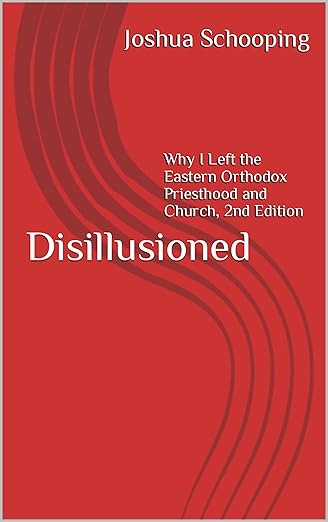
Disillusioned: Why I Left the Eastern Orthodox Priesthood
Joshua Schooping
The Eastern Orthodox Church presents many conundrums for those who are seeking to assess its theology. Although there is much within their rich Patristic heritage that is a cause for appreciation, the present book seeks to provide a critical analysis of certain of its core canonical claims, especially as these relate to iconology, Mariology, and ecclesiology. The contents of this book by a former Eastern Orthodox priest will help provide the reader with tools to get past superficial assessments in order to penetrate where the real problems within the Eastern Orthodox Church reside.
Schooping sets the groundwork by establishing that, while there is a diversity of opinion within Orthodoxy, there exist sufficient sources they broadly accept as canonical, which are used to establish Orthodox doctrine. On this basis Schooping describes Orthodox doctrines regarding icons, Church, and Mary and how they have ignored history, bypassed discordant Church Fathers’ views and, most importantly, dishonoured Christ and contradicted the Gospel.
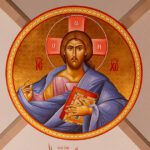
Orthodox iconology
Schooping contrasts the clear Scriptural injunctions against the use of images in worship against Orthodox doctrine that not only tolerates but insists upon the practice. He cites the canonically binding Seventh Ecumenical council which charges that not only must images be “saluted” and kissed but “one must also have emotional affection for them,” (p. 54) with the threat of eternal condemnation to those who do not comply.
Yet Schooping demonstrates that this Byzantine view was a departure from that of the early Church where images were tolerated but not venerated. In this Orthodoxy does not stand in continuity with the original Church as they claim but are instead the adopters of novel doctrines — the charge they commonly level at Protestantism.
However, I disagree with Schooping’s suggestion that the basis of the Biblical objection to icon veneration is that they are inanimate. He draws on passages like Isa 44:14-17 that mock the worship of that which is lifeless to suggest that this is why it is forbidden. However, the more important Biblical idea is that true worship belongs to God alone. To ascribe worship to anything or anyone else is the heart of idolatry. That is why Romans 1:25 condemns any worship of the created rather than the creator and the absolute prohibition of Deuteronomy 4:15-19 to worshipping images of anything or anyone. Indeed, the Biblical definition of idolatry is of anything that supplants God’s rightful place as the one whom we must serve. This is why greed is (not like) idolatry, and why Calvin concludes that our sinful hearts are idol factories, constantly manufacturing objects to which we give our devotion. An idol is anything that takes the rightful place of God, which includes images, but is not limited to them.
Orthodox Mariology
However, the most helpful section for me dealt with Mariology. As a cradle Orthodox I was surrounded by an atmosphere of deep devotion to Mary but always struggled to understand the drivers behind it. At least as far as the doctrinal underpinning, Schooping does a great service in describing Orthodox Mariology in great detail.
Schooping cites numerous non-Biblical sources which are considered canonical in Orthodoxy that describe Mary as the active procurer of the salvation of the world. One intriguing and repeated myth describes Mary as growing up in the Holy of Holies (yes, the one in the Jerusalem temple) where she lived such an intense life of self-denial that she gained favour with God. With it she convinced him to take compassion on the world and to enact her plan for salvation.
She took it upon herself to represent us, to constrain Him who is above compulsion and quickly draw Him towards us, that He might remove the curse from among us (p. 90).
In addition, Orthodox doctrine describes Mary as the second Eve, the fulfilment of humanity, and the “the ewe-lamb of God without spot, the dove without blemish” (p. 83), who reverses the curse upon us. She is even described as an “acceptable sacrifice”, “the preordained Queen of all who has opened the Kingdom of Heaven unto us,” (p. 85) and the compassionate and approachable heavenly being who lives to intercede for us evermore.
I can only say that reading about this was as eye opening as it was shockingly blasphemous.
Schooping’s most generous observation is that there is a “deep, thoroughgoing confusion and ambiguity regarding Mary’s soteriological role and agency” (p. 96). But more realistically he concludes that,
It does not seem at all unjustified in this to at least suspect with all seriousness a kind of Mariolatry, even a Marianity existing within Christianity (p. 104).
What rightly disquiets Schooping is that the most embarrassing of these doctrines are glossed over by Orthodox apologists seeking to attract unsuspecting converts. He finds this disingenuous at best and,
…an odd self-contradiction that so many Eastern Orthodox Christians, even theologians, so often want the “unchanged” and “only true Church,” and yet take arbitrary exception to or explain away various aspects of its formal canonical life (p. 30).
Who is this book for?
Schooping himself suggests in the preface that those of eastern Orthodox background are not the intended audience. Yet there may be some well-read converts who will find their doctrinal questions addressed by Schooping’s critiques.
However, Disillusioned is certainly for evangelicals investigating Orthodoxy either because they are attracted to it or looking to understand it better and defend against it. This book is also for the many pastors with whom I have conversed who are concerned for the members of their congregations who are attracted to Orthodoxy. Yet, while I found it easy to read — and actually hard to put down — Schooping uses theological and philosophical concepts that will make it hard going to anyone unfamiliar with them.