


I was sad when Stan Grant quit Q and A and stepped back from public life in 2023. The constant online bullying and racism exhausted him, and he withdrew to protect his family and repair his mental and spiritual health. I find Grant a fascinating figure with a sage-like presence. Murriyang: Song of Time mingles both his Roman Catholic faith and Aboriginal heritage in a prayer-like meditation on grief, politics, and worship. He describes the book as a “psalter.”
Licking His Wounds
Between his 2023 departure from the ABC and his release of both Murriyang (2025) and its secular equivalent When Words Fail Us (2026), Grant has done more than lick his wounds. He completed a doctoral thesis titled “Yindymarra as Theology: Identity, History, Violence, Faith and Reconciliation”, with St Mark’s National Theological Centre in Canberra. Murriyang is his offering to the Christian world based on this work, melding his Aboriginal Christian upbringing and oral teaching from his parents and “aunties”, with a rich theological grounding in the Roman Catholic tradition.
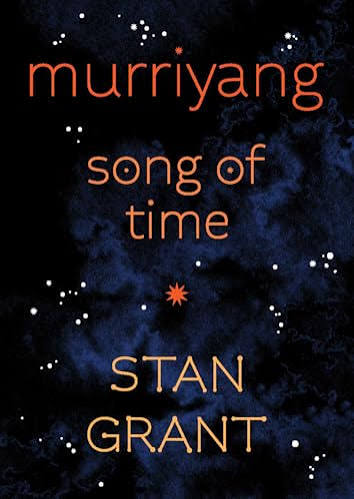
Murriyang: Song of Time
Stan Grant
Stan Grant is talking to his country in a new way. He offers a means of moving beyond the binaries and embracing a path to peace and forgiveness, rooted in the Wiradjuri spiritual practice of Yindyamarra – deep silence and respect.
The language is respectful yet painfully honest, with a clear and conciliatory account of his faith. Simone Weil, John Donne, Augustine, and Pope Benedict are cited to gently offer a certainty of faith to a spiritually diverse readership. He engages with ancient Greek philosophy, seventeenth-century mathematics, the scientific method, and other foundations of Western civilisation before contrasting these frameworks against the unhurried and embodied constructs of time and space in Aboriginal pedagogy and theology.
Memories and Essays
The book alternates between short interactions with Grant’s memories of his father (each titled Babiin—a tribute to fathers in Wiradjuri language) and essays to a confused, polarised, and hurting world that are titled Murriyang (A Wiradjuri name for the sky-world). Each chapter is short enough to read and reflect upon in one sitting, giving insights that bear repeating and re-reading.
The first Murriyang is a lament, followed by the first Babiin, a reflection on the Wiradjuri language, followed by a Murriyang that shows the author’s early formation in Aboriginal churches and how his faith has now developed, in conjunction with his identity as a journalist and public figure.
The second Babiin is about his father’s love of music and music’s power to voice the unspoken and unspeakable. The second Murriyang introduces the Wiradjuri concept of Yindymarra, which is “quiet, respectful, kind and forgiving” living (Preface). One Babiin simply reads “Dad, I’m sorry” (p. 189).
These two forms of song alternate without naming or numbering; I counted twenty-three. They engage with issues such life, death, grief, worship, alienation, modernity, hope, history, war, and the holocaust. Each Babiin provides a Wiradjuri understanding related to Grant’s father and the corresponding Murriyang engages with a topic using a range of influences and sources that Grant has devoured over the last few years.
Expectant Religions?
A theology of Aboriginal spirituality is skilfully outlined with scriptural reflection. The first Murriyang contextualises this understanding. Pope Benedict is cited to argue that “‘tribal religions’ are ‘expectant religions’, awaiting the encounter with the light of Christ, and… Christ is waiting for us” (p. 19). Grant is perhaps attempting to engage Aboriginal people with traditional beliefs to meet the God of the Bible in Jesus. Evangelicals are likely to find problematic the idea that Aboriginal spirituality is expectant of Christ. The Bible is explicit that God’s divine power is evident from creation in Romans 1 and the aboriginal dreamtime stories do not acknowledge God who we meet in Christ.
Contextualisation
The Aboriginal terms for faith, grief, God, and spirit are used in place of the English words. Aboriginal words that have no equivalent word in modern English are explained in English phrases. Continual translation and contextualization shows how meaning and learning can go back and forth between traditions and cultures.
Grant does not argue that all Aboriginal spirituality is equivalent to Christian spirituality, but he’s setting forward his belief that these spiritualities are seeking the true God and the true faith. He also pushes back on some Aboriginal ideas that go against his faith. For example, he engages with the Aboriginal idea that the country is god; “that’s not what dad taught me. Country is God’s gift to us” (p. 139).
Whither Modernity?
Modernity is eschewed. He appears to be sifting through what is worth keeping and treasuring in a world that races forward headlong into technology that humanity might regret. In reaction to modernity, Grant commends Christian mysticism.
Murriyang is a call to retain what is good from the history of the West and the wisdom and embodied experience of the land that the Aboriginal people have. Grant’s book presents as a prayer for our world: that people will not be captured by the shiny, the modern, and the self; but instead be drawn to the divine.
Grant’s last Murriyang articulates hope for Australia and a world craving more than what we can see:
Enough of identity, enough of modernity: I want nothing more of it. Thankfully it won’t last; we are watching the end of this five-century experiment of the celebration of the self. I know it won’t last because human beings crave the divine (p. 248).
Murriyang embodies and explains what it is like to be both spiritual and religious, synthesising early formation with later reading. This book is designed to be read slowly, to savour, and ponder. Grant offers a thought-provoking take on faith for those who are disillusioned with contemporary politics and curious about spirituality. Evangelical readers, mindful of its various theological influences, can benefit from this singular work, overflowing fresh ideas, spiritual exploration, and touching personal material.
Murriyang: Song of Time was a finalist for the Christian Book of the Year award.