




In the early days of my Christian life, I was part of a lively university Christian group. One seminar we did involved selecting a bible verse or passage that summarised the whole gospel, then discuss whether and why it covered the main aspects of the gospel. I remember a friend passionately explaining why he had chosen 2 Timothy 2:8: “Remember Jesus Christ, raised from the dead, descended from David. This is my gospel.”
He loved that the text stated Jesus’ prophesied lineage and his rising from the dead (implying his death) and used the term “gospel”. I can’t remember my selection, but I vividly remember his excitement at finding something so concise and powerful in one verse. The amazing depth of the mystery of God’s gospel, expressed with economy and delight.
Our group of passionate twenty-something university students would have received Tim Patrick’s The Amazing Depth of the Simplest Truth: The Gospel and Gospel Theology with great enthusiasm. perhaps all evangelicals go through this process of finding a gospel summary int he bible as a rite of passage. But if you haven’t yet, then this book will help you reflect on what the gospel is and how it shapes our lives, our work, ministry, and responses to suffering and joy.
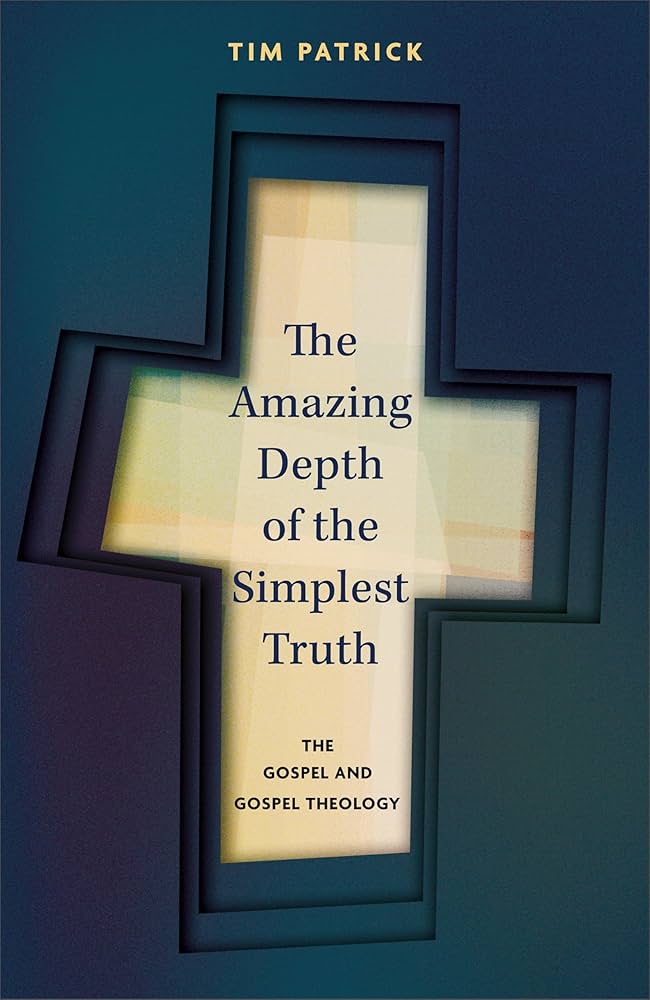
The Amazing Depth of the Simplest Truth
Tim Patrick
We live in interesting times. The gospel hasn’t changed, but the recent explosion of new presentations and differing emphases means that the Church needs to return to the teachings of Jesus, considered in the light of the whole counsel of God.
Tim Patrick shows how the gospel is the nexus between theology and ministry. He challenges overly pragmatic approaches and encourages us to see the practical importance of Christian doctrine.
So. Many. Gospels
As our secular world grows more “spiritual” but less “religious”, there are more “gospels” for us to engage with respectfully as we articulate the truth of Jesus. The National Church Life Survey (NCLS) identified 13% of respondents as spiritual but not religious (SBNR) in 2018. Later studies show that SBNR groups had grown to 30% of Australians in 2024. Holding to the gospel with clarity, joy, and courage has never been more important than today, when other gospels abound.
Why is the gospel so important? Why write a whole book about it? The answer to this question bears repeating. Paul was passionate about “the preservation of the genuine Christian gospel” (p. 1), he risked his life repeatedly to keep it intact. It feels extremely fitting that Tim Patrick begins his book with the urgent and passionate entreaty from Paul in his letter to the Galatians.
One Gospel. Ten Chapters
In that letter, Paul moves briskly from salutations to rebuking the Galatians for abandoning the true Gospel of God. Tim uses the book of Galatians to scope his book in his introduction.
The introduction and chapter one of the book is grounded in the gospel’s ancient context, in which the Christian gospel was a newcomer to religion and belief, competing with other gospels. Patrick also reminds us that today’s churches are shaped by new perspectives on Paul as well as different gospel emphases, such as social justice or conservative culture. Even in relatively aligned evangelical churches, these differences need to be discussed.
Chapter two is the same exegetical exercise I did back in the 1990’s. Individual biblical passages are examined and weighed against the essential points of the gospel that Paul describes in 1 Corinthians 15. This exercise examines scriptures that summarize the gospel, while isolating the gospel message from pastoral concerns and other important (but not essential) parts. Patrick summarises the gospel in five points (p, 37–38):
- The death AND resurrection of Christ, as co-central parts of the gospel
- The cross and resurrection as equally important and distinct theological aspects of the gospel
- That these two aspects need to be contextualized as consistent with Old Testament prophecies, narratives, and systems. The Old Testament is not part of the gospel, but necessary scaffolding for the gospel.
- Christ cannot be reduced to his Kingship or Priesthood, or to his life and ministry as healer, preacher, and lover of sinners. The gospel is about Christ, who is both fully human and fully divine, but the focus is on his dying and rising to resolve the problem of sin.
- Elements surrounding proof of Jesus’ death, (such as his burial) provide context but are not essential to the gospel.
This chapter does not mean to diminish other emphases of the Bible, but to strip our perception of Christ and his gospel back to its foundations, as Paul does in 1 Corinthians 15.
Chapter three zeros in on the two events raised in chapter two, the death and resurrection of Christ, providing a detailed analysis in reference to scripture and historical theology. I particularly appreciated his explanation of the theology of Christ’s death, as truly man and truly God:
His death is not him being extinguished, it is him suffering the dreadful pulling apart of that (body and soul) which ought never to be divided. He suffers the horrors that every human has faced since the fall. (p. 53)
Chapter four is a detailed theological overview of the gospel using pre- and post-Reformation sources. Chapter five delves into Jesus’ human, and divine nature and Chapter six is an in-depth exploration of the historical prediction of and fulfillment of the gospel through Old Testament prophecy.
Chapter seven makes a case for a new type of theological study, one which Patrick calls “gospel theology.” This theological system seems to be the heart of the book. Patrick wants us to adopt the idea of “gospel theology” as a unifying schema for reading Scripture, in a similar way to biblical and systematic approaches to reading Scripture.
Chapter eight turns its attention at last to the problem of sin, in which the vision of gospel theology is further unpacked. Gospel theology aims to combine disparate theologies such as ecclesiology and pneumatology so that our perceptions of the gospel shape our entire worldview. Chapter nine shifts from a more academic study of the gospel to encourage us to let the gospel shape our practical day by day ministry. Chapter ten summarizes the book and reminds us that there are many ways to emphasize Jesus and the gospel. Patrick urges us not to skew too far in one direction or the other, but also not to rigidly judge those who we might perceive as having the “wrong” gospel balance.
Queries
Tim has aimed to establish the concept of “gospel theology” to merge biblical and systematic theological frameworks for understanding the Bible. I’m probably not the best person to engage with this proposed framework, having no formal theological training. I hope other theologians might engage with this attempt, so that it can be further developed. I’m convinced that we need a gospel shaped worldview, but I’m not convinced we need a gospel theology to achieve that.
The Amazing Depth of the Simplest Truth is an accessibly written theology book for pastors, lay leaders, and twenty-something university students. It would make a good discipleship book for mentoring aspiring theological students or ministry apprentices.