




Today’s church is cowardly and paralysed by inaction. It no longer puts emphasis on communities. It fails to connect with people gathered in the public square of social media. Liberalism is white anting its central beliefs from within. It overlooks the poor and marginalised. And it turns a blind eye to persecuted Christians in tyrannical nations.
Christians love all people and care for all marginalised people. But it’s almost as though public Christians are so scared of being seen to favour their fellow religionists that they hardly ever speak up for them (p. 359).
So believes Australian newspaper journalist and public intellectual Greg Sheridan, who pulls no punches in his latest book How Christians Can Succeed Today: Reclaiming the Genius of the Early Church. Sheriden is a practising Catholic (p. 128) who regularly attends church because “it’s important to me” (p. 355). The first six chapters outline the ‘revolutionary Christians of the early Church’ while the final chapters are separate interviews with six ‘contemporary ‘early’ Christians.’
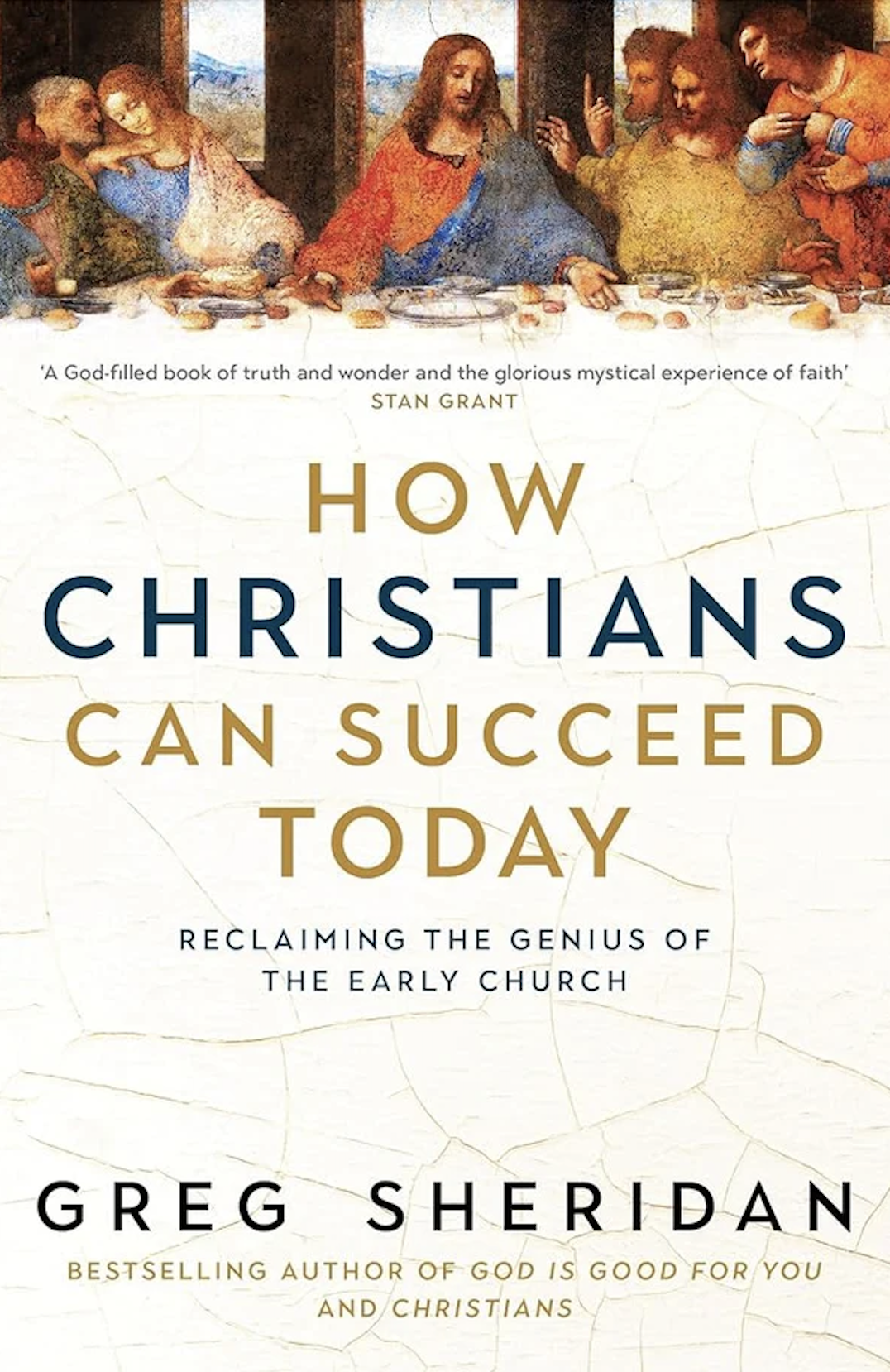
How Christian Can Succeed Today: Reclaiming the Genius of the Early Church
Greg Sheridan
Purchase from WanderingHow Christian Can Succeed Today: Reclaiming the Genius of the Early Church
Greg Sheridan
There is a deep, pervasive crisis of meaning and purpose across all Western societies today. Greg Sheridan encourages us to listen to the voices of the early Christians and emulate their commitment, integrity, resilience and smarts. He shows how early Christians built communities, met persecution with courage and grace, dispensed universal mercy during plagues, pioneered equality for women, and redefined the nature and purpose of the human experience, always with Jesus Christ at the centre of their lives.
Sheridan spends most of his book artfully circling the canvas, beckoning the church to put up its dukes and fight for its survival. Rather than landing a knockout blow, Sheridan ends up giving a “shoe shine” — a collection of fast and bruising hits, which look good for the crowd but ultimately won’t win the bout.
Early Rounds
Sheridan spells out his central argument immediately: “The early Christians … lived in hostile, pagan cultures. And yet they were astonishingly successful. They turned world history on its head” (p. 1). Their countrymen ridiculed, ignored, dismissed, or hated them, but instead of giving up, they spread the Gospel which speaks “to the truths of the human heart” (p. 11). As Sheridan points out:
The radical love of God, the message of God’s love for humanity, the radical love of their fellow human beings and the sheer Jesus-centred cultural weirdness of the early Christians were the keys to their success (p. 38).
He then devotes half of his book to skilfully recounting this success. The following reasons for this success are presented. The journeys of Paul spreading the Gospel by not bowing the knee to pagan society, but ‘using whatever legal and political defences were open to him’ within those societies (p. 50). The original sexual revolution, which elevated marriage, women and children, but also liberated men from cultural misogyny and pagan machismo. The rejection of infanticide, especially of girls. The fight against pederasty suffered by pubescent boys. The care for neighbours during plagues. The raising of money to buy the freedom of slaves. There are dozens more incredible examples of faith in action.
Split decision
Today’s church needs to follow their example, Sheridan pushes, rather than throwing in the towel. Western Christianity needs to accept that it’s no longer the default position of most societies, nor are Christians the majority (p. 349). “Christians are living through the greatest civilisation-wide change in religious outlook since the conversion of Emperor Constantine to Christianity towards the end of the Roman Empire” (p. 347).
Unfortunately, some sections of the church think they’re still living in Christendom, rather than an apostolic age — an idea Sheridan sources from American Catholic priest and president of the University of Mary, James Shea, author of From Christendom to Apostolic Mission. Christendom is a society wherein “Christian belief, ethics and culture are the predominant influence on public life” (p. 347). Citizens may give lip service to Christian values or even be corrupt but their “master narrative is Christian” (pp. 347-348). Church leaders who still think they live in Christendom will “be administrators rather than apostles” — slow to adapt, ineffective, and still vulnerable to controversies raised against the faith (p. 349).
An apostolic age is an age where Christianity and its values are widely rejected. Believers should be “apostles for the faith, presenting the faith in all its magnificence to an uninterested or hostile society. Just as the early Christians did” (p. 348). Such churches will be more mobile and better at handling the attacks that will inevitably come but will need to battle for their rights and be constantly counter-cultural.
The danger for apostolic age Christians, however, is cowardice: “pretending to care less about Christian truth than you really do” (pp. 350, 352). In other words, publicly expressing your faith will be costly. Talking about your faith may affect your future job prospects, he predicts.
Body Work
Sheridan’s journalistic clout comes to the fore in the second half, as he shows how Christians are positively impacting the world today. He interviews several Christians from different walks of life, including former US Vice President Mike Pence, British-American historian Sir Niall Ferguson, and American film and TV director of The Chosen, Dallas Jenkins. Most are insightful, refreshing and nimble, but a few interviews feel less consequential and should have been dropped.
As always, the most powerful story belongs to rank-and-file Christians, namely Leila and Danny Abdallah from western Sydney, whose three children and niece were killed in February 2020 by a car driven by a man under the influence of alcohol and drugs. The Abdallahs’ forgiveness of the driver, Samuel Davidson, and his own subsequent conversion to Maronite Church is not only one of the most powerful examples of forgiveness in living memory, but incredibly Christ-like (Matt 5:44, Luke 6:27-28, Col 3:13).
The most surprising interview, however, is with Canadian psychologist Jordan Peterson, who has notoriously been a bit of a unicorn when pinning down his exact religious beliefs. Sheridan asks point blank: “Do you yourself believe that Christianity is true … that Christ is the Son of God?” (231). Peterson answers, “I’m certain that it’s true. I wouldn’t claim to be able to explain what that means because I don’t know what it means” (p. 231). Sheridan walks away accepting that Peterson “does indeed believe that Jesus Christ is the Son of God” (p. 235), but little proof is offered to the reader. The unicorn still runs free, it seems.
Check Hook
How Christians Can Succeed Today is a persuasive, easy read for the casual, secular reader, but reformed evangelicals will struggle with some of its theology, gentle Catholic apologetics, and kid-glove approach to Pentecostalism, especially the idea of “rewards” (pp. 224-225). That’s surprising considering the several high-profile Protestant leaders who openly gush about the book in the five pages of endorsements. Maybe their suggestions were politely turned down? Maybe.
Two issues stand out. First, possibly due to the author’s own Catholicism, the book has a problem with original sin. Sheridan asserts, “all human beings are prone to corruption” (p. 129) and “people are good, but they are always tempted to bad” (p. 171). No, we are born sinners (Ps 51:5) and every heart is corrupt and dead (Ps 14:2-3, Eph 2:1-3). It explains why all the world is hostile to Christianity all the time, not just now.
The second issue is the underlying works-based revival: all the church needs to do is roll up its sleeves to win back the masses.
Counterpunch
And most of us would love for him to be right. How amazing it would be to have a new generation of Christian leaders like Paul, writers like Augustine of Hippo, or 3rd century martyrs Perpetua and Felicity standing up against today’s gluttonous idols of comfort, materialism, and self-worship.
But here’s the counterpunch: they already exist. Ask the thousands of African women who have been healed in fistula hospitals overseen by Dr Andrew Browning or the late Dr Catherine Hamlin. Sit with the lowest caste in Indian society, the so-called “untouchables”, who have found worth and acceptance in Christ. Step aboard the Mercy Ships, whose volunteers sail to developing nations and provide medical aid and surgery to untold numbers. Join the fun of a Jesus Club, which ministers to people with intellectual disabilities. Or talk to International Justice Mission, which fights human trafficking with the help of local authorities.
They’re just a minute percentage of Christians making an impact on the world every day. Their stories are rarely, if ever, told. If the thousands of Christians being killed each year aren’t worthy of a headline, then why should the good work that they do be more worthy?
And this is why reformed Christians will struggle with the book’s core argument. A works-based approach is never the answer to the church’s success. The answer to the church’s success is the Gospel. It’s the Great Commission (Matt 28:16-20). The two go hand-in-hand. Sure, build orphanages and hospitals, that’s the work of the Christians too. But ultimately one has to encounter the person of Jesus through his living word.
Sheridan says early Christians “knew the danger of going soft on their teachings” (p. 50) but he surprisingly doesn’t have a major swing at today’s church, which is gangrenous with such false teachings (2 Tim 2:17). Pity. Because that’s where he would’ve landed his knockout blow.
Disclaimer: The reviewer and author worked together at The Australian newspaper for more than a decade.