






As a church pastor, I can tell you that there are few things more discouraging than complaints. We tend to feel under attack and immediately break into defence mode. “How dare they criticise my preaching!” “What would you know about the pressures of trying to organise and run a church?!” “They complain about us not being friendly, but they don’t make an effort!” “It’s not my fault!!!” Maybe we could do with a fresh perspective.
A Complaint is a Gift by Janelle Barlow is a helpful challenge to rethink complaints. I read the first and second editions of this book many years back and found them liberating and empowering. Since the earlier publications of this book the forum for complaints has gone ballistic. A tweet, Facebook comment, or one star review can destroy a product or business. Word-of-mouth goes viral, quickly becoming ‘world-of-mouth’ in a matter of minutes. The third edition of this book (2022) accounts for these changes, incorporates ‘complaints’ and feedback from the earlier editions, brings readers up to date, and introduces suggestions about how to make complaints, how to not take them personally, and how to use the internet constructively.
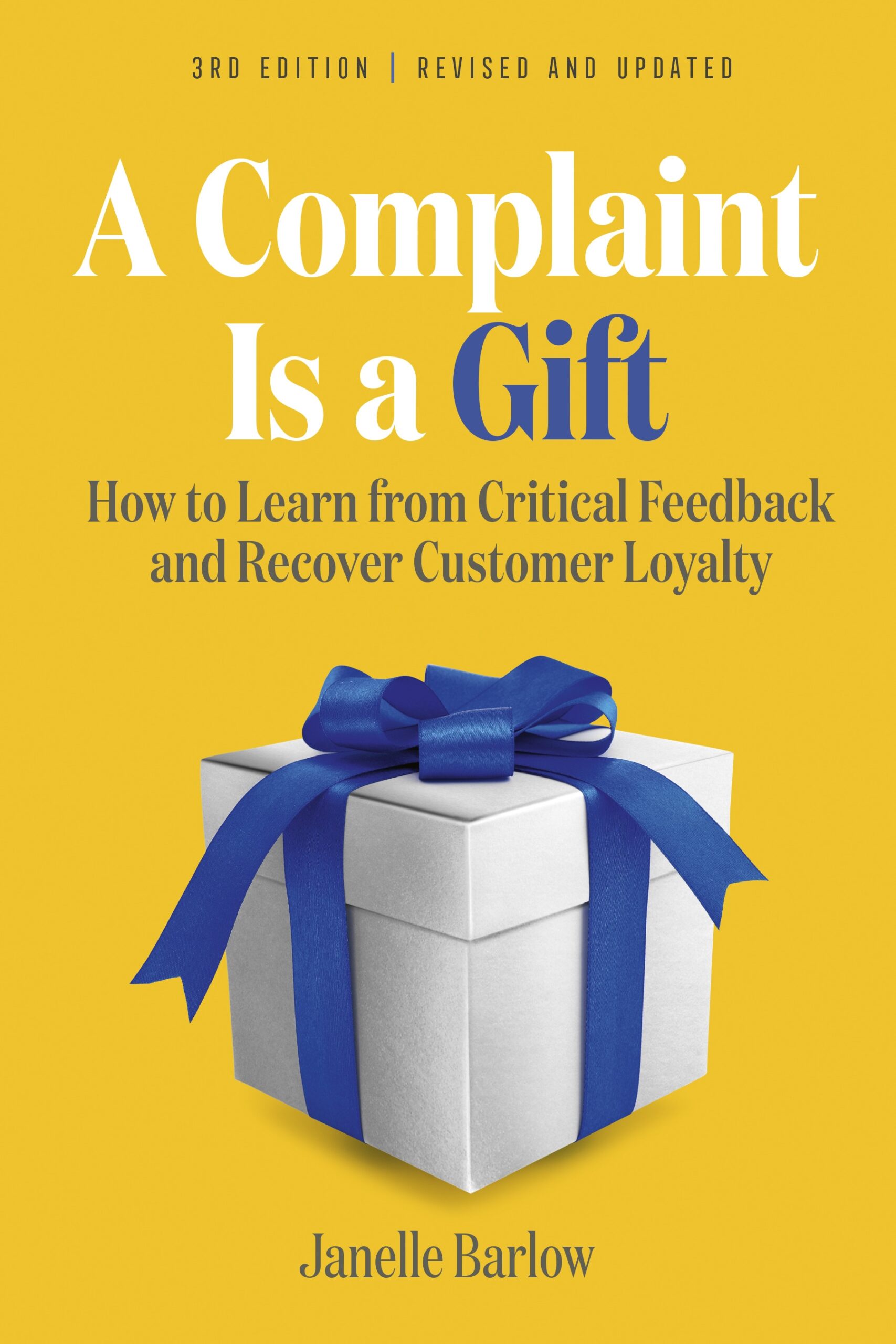
A Complaint is a Gift: How to Learn from Critical Feedback and Recover Customer Loyalty
Janelle Barlow
Purchase from AmazonA Complaint is a Gift: How to Learn from Critical Feedback and Recover Customer Loyalty
Janelle Barlow
Handling complaints doesn’t have to be a negative, soul-crushing experience. Janelle Barlow gives the right tools to treat each of them as a source of innovative ideas that can transform your business.
Redefining
What is a complaint? Fundamentally, it is a statement about expectations that have not been met. But more importantly, it is an opportunity for the organisation, or church in our case, to make some helpful changes. This book calls upon us to redefine complaints as gifts. This will require us to separate the message from the medium. We must distance the content of the complaint from the emotions that accompany blame. Simply, we shouldn’t take things too personally!
Reengaging
This will mean gaining empathy for the disappointed people and rethinking how complaints can help us move forward as a church. The very fact that people make the effort to complain indicates some level of commitment to us. Many will only grumble to others or simply walk away. We do well to put ourselves in their shoes. Imagine that the cause of their complaint had happened to you. How would you react? What would need to happen for you to be satisfied?
This book warns against a strategy of aiming to reduce the number of complaints. Complaints can be avoided by closing lines of communication. But this simply buries problems and maintains a poor state of affairs. Instead, we should create opportunities for feedback. We can do surveys from time to time, but they will never adequately reflect the levels of dissatisfaction. Such people are unlikely to wait for the next survey to air their complaints. Maybe they’ve already walked away in frustration.
Churches, like businesses, depend heavily on word-of-mouth advertising. The way we handle complaints will work for or against us. People are much more likely to believe a friendly recommendation than formal advertising. If we handle complaints well it can be a powerful source of positive word-of-mouth. On the other hand, the more dissatisfied people become, the more likely they are to spread bad news. I couldn’t tell you many times we’ve had people turn up at our church, saying things like “I used to go to… but I left there because…” And I’m sure there are plenty who’ve left our church, headed elsewhere, and told a similar story. So much movement and pain could probably have been avoided if we’d done a better job of listening to complaints.
Audience
While written with the business sector in mind, this book has value to a much wider audience. The issues raised are relevant for personal relationships, resolving conflict, and improving communication. At a time when people are craving connection, pleading to be heard and understood, churches and their leaders would do well to take notice. While some will read the book and be motivated by the desire to increase profits, pastors should read it with a regard to people’s souls.
Re-Strategising
A complaint is a gift (3rd ed.) examines strategies for developing a positive mindset toward those who complain. It helps us to understand what is going on when someone complains, and how they are likely to respond when they are not satisfied. The book offers superb advice on how to handle complaints well. It develops a three-step gift formula for keeping our words and actions consistent with the belief that the complaint is a gift. Each step is broken down further:
The three responses are:
1. Respond by building rapport
Thank the customer for complaining.
Explain why you appreciate the feedback.
Apologise where appropriate.
Let them know you intend to help resolve the issue.
2. Recover by fixing the issue
Ask for the information you need.
Take action to correct the problem promptly.
Check back with the customer to make sure they are satisfied.
3. Address the issue internally
Use the complaint as information for the organisation.
Identify what caused the problem and make changes to prevent it happening again.
This is probably not a book that many church leaders would think to add to their libraries. You probably wouldn’t buy it to help resolve conflict with your neighbour or a work colleague. I doubt you’d be impressed if I recommended it for strengthening your relationships with your spouse or children. However, this book offers practical help for all these scenarios.
Biblical Wisdom
Of course, the bible has contained this wisdom for centuries. It hasn’t been revised or improved, but it doesn’t need to be. Read these gems:
He who listens to a life-giving rebuke will be at home among the wise. Proverbs 15:31
A gentle answer turns away wrath, but a harsh word stirs up anger. Proverbs 15:1
A mocker resents correction; he will not consult the wise. Proverbs 15:12
Whoever gives heed to instruction prospers, and blessed is he who trust in the LORD. Proverbs 16:20
Pleasant words are a honeycomb, sweet to the soul and healing to the bones. Proverbs 16:24
However, it’s not just the head that needs to change, it’s our hearts. The temptation is often there to take things personally out of pride, or to get defensive because we want to look good before others, or to blame others because we don’t want to confront our own selfishness. What we really need is for God to renovate our hearts and minds, to transform us from the inside out. When you read the gospels about Jesus, you can see how he modelled and taught that genuine humility is the key to relationship with others. Christians have a special reason to listen and respond well to others. As it says in Philippians 2:
1 If you have any encouragement from being united with Christ, if any comfort from his love, if any fellowship with the Spirit, if any tenderness and compassion, 2 then make my joy complete by being like-minded, having the same love, being one in spirit and purpose. 3 Do nothing out of selfish ambition or vain conceit, but in humility consider others better than yourselves. 4 Each of you should look not only to your own interests, but also to the interests of others.
5 Your attitude should be the same as that of Christ Jesus:
6 Who, being in very nature God,
did not consider equality with God something to be grasped,
7 but made himself nothing,
taking the very nature of a servant,
being made in human likeness.
8 And being found in appearance as a man,
he humbled himself
and became obedient to death—
even death on a cross!
This is updated and revised from a review on an earlier edition of the book at https://macarisms.com/2012/03/16/a-complaint-is-a-gift/