
From time to time, a book is released that fills a big gap. Darby Strickland’s When It’s Trauma does this by showing us what patient and compassionate conversational ministry for trauma looks like when our God and Saviour, Jesus Christ, is integral to the process. When It’s Trauma is for anyone who wants to come alongside someone who has been harmed by trauma. Pastors, elders, small-group leaders, friends, family members, and professional counsellors will be helped by this book. The author is a faculty member of the Christian Counselling and Educational Foundation in Philadelphia (CCEF). She writes with many years of experience in trauma, domestic abuse, and relationships. There are free downloadable resources that help church leaders work through the book’s content.
Strickland provides this summary of the book’s content:
Part 1: Foundations of Care. We begin not with strategies but with presence. With listening. With seeing… we explore how we can be wise companions to people who are walking through deep suffering—and how Jesus himself draws near to the broken-hearted.
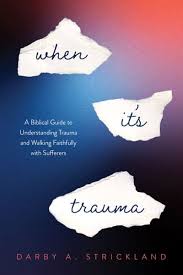
When It's Trauma
Darby Strickland
Trauma is commonly referenced and frequently misunderstood. In this comprehensive resource, counselor Darby Strickland empowers helpers to recognize signs of trauma and walk alongside sufferers in an informed, helpful, and Christ-centered way.
Part 2: Wounds of Trauma. We delve into specific wounds caused by trauma. Each chapter… follows a similar structure by defining and describing one of those wounds, showing how Scripture portrays it, overviewing its impacts on a sufferer, and then explaining how a helper can provide support. Some suggestions will be most practical for formal counselling relationships, while others may be useful in any context. Each chapter also includes discovery questions you can ask a sufferer to learn more about their experience.
Part 3: Hope of Restoration. We end by exploring the slow, sacred journey of restoration after trauma, drawing from the books of Ezra and Nehemiah to cast a hopeful vision of how sufferers can rebuild amid the rubble. Healing from trauma is rarely linear—it weaves grief with worship and progress with resistance—and so it requires the steady presence of Christ and his people.
The Lord as Our Deliverer and Counsellor
The book communicates a humble, clear, and hopeful message: that the Lord is our deliverer and counsellor. Strickland is not the deliverer and counsellor; not me; not you; and not a counselling relationship or counselling method. As instrumental as these people and methods are, and obviously loving and skilful as Strickland is, the Lord is our deliverer and counsellor. The Lord is with us, in his love, gentleness, and power, leading by his word and his Spirit. To the believer’s ear this sounds wonderfully hopeful.
Hoping in the Lord and looking to him in all things is at the core of the most helpful approaches to trauma. Strickland models this in the fine details of extended counselling relationships which he shares in this book, while exhibiting the interventions that the wider counselling world has also found to be beneficial. Yet her approach is deeply rooted in Scripture—the lens of Scripture is used to interpret everything, and her words sensitively and wisely express the word of Christ.
Practical Helps
Strickland’s ‘ministry of presence’ is a wise, biblical, and necessary corrective in a culture where pastoral care can be rushed and efficiency is overly valued. The ministry of presence is the appropriately paced personal and private ministry of the word that starts by saying little. This approach should help many to relax and really listen with care and prayer before speaking gently and slowly.
A short appendix on Christian empathy and the problem of enmeshment (unhelpful over-involvement in the helping relationship) will be helpful for those who may get too caught up in the life and experience of others—especially when caring in local church contexts that don’t have the usual boundaries of a professional counselling centre.
Trauma and Song
Singing can be a healing response to trauma, trouble, and distress, as found in so many Psalms, other parts of Scripture, and in the world around us. There are clearly unique benefits from singing to ourselves and the Lord, hearing him in return through his word, getting physiological benefits from an in-built breathing exercise, and comfort from musical sound and vibration, which resets rumination.
Strickland endorses singing out loud while alone, despite it not being a mainstream therapeutic intervention in contemporary counselling when the book was written (p. 16). She says, “many of my counselees have learned to call on the Lord by singing a song that encapsulates a comforting reality” (p. 222). Strickland argues that Psalms helped traumatised people find their voice despite embodied distress (pp. 92-9). The ancient psalm-singer of Psalm 42 exemplifies singing God’s songs at night, foreshadowing Strickland’s modern observation that her counselees sing to the Lord to ease their distress—self-soothing both body and soul.
Strickland’s recommendation to actively imagine God singing over us in his undefeatable redeeming love and compassion is valuable. There is blessing to be found for those who meditate upon the beautiful and comforting image of Zephaniah 3:17, where our God sings over us and ‘quiets (us) by his love’ (p. 127).
In all, I find myself in close agreement with what Strickland says about counselling ‘when it’s trauma’—I expected that. The unexpected thing is that I find myself wanting to be like her in my own work in a way that books do not usually inspire me—imitating her as she imitates Christ Jesus. And that may be the highest praise—seeing the heart, character, and wisdom of the Lord in the ministry of another in such a challenging area.
Darby Strickland is scheduled to speak on trauma and domestic abuse in Australia in 2026, in Melbourne, Sydney, and Brisbane.