




Last year, I wrote an article about the limitations to the justifiably popular ‘big idea’ approach to preaching. In the search for clarity and cohesion, Scripture itself can be over-simplified, and the contributions of distinct texts can be diminished. While structuring a sermon around a big idea is a very effective approach to writing a sermon, it is not the only faithful one. There are other structures that can facilitate a coherent and dynamic sermon, where a big idea is not the dominant organising principle. Some of these structures also better suit the natural abilities of a preacher and the main ways they order their own thinking.
Induction
All exegesis ought to be inductive, seeking to discern the meaning in the text itself, as intended by the original divine and human author. However, once the exegetical work of listening carefully to the Bible has been sufficiently performed, a big idea is formulated and major supporting ideas are placed in logical relationship to one another, together constituting or strengthening that central idea. Expounding these ideas in a sermon has a more deductive shape.
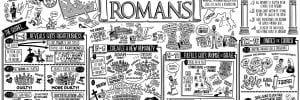
Some passages of Scripture are best handled using an inductive rather than a deductive approach. In deduction, the main idea is proven by each section of the passage. In an inductive approach, the Scripture is explored, step by step, with naturally observable sections providing some shape to this exploration. As this process continues, a cohesive impression emerges. A deductive approach to Romans 3:21–25 might offer a big idea such as “God declares sinners right by faith in Jesus’ sacrifice”, that is then broken into supporting ideas such as: “we are all sinners”, “God declares sinners right by Jesus’ sacrifice” and “sinners are declared right by faith”. An inductive approach might instead observe that the passage presents the righteousness of God in the gospel is “old but new” (v. 21), “to all who believe for all have sinned” (vv. 22–24) and “free but fair” (vv. 24–26). Following the train of the argument gives structure to the sermon, and a series of interdependent and glorious truths are drawn out in the process.
Story
A big idea approach to a section of Scripture that tells a story usually digests the meaning of the story, and then structures the sermon around more general principles that are manifested therein—“the faithful cry out to the Lord”, “the Lord is mighty to save”, and so on. However, a narrative sermon can be unified and structured around the story itself—whether some equivalent of three acts, a symmetrical chiasm, or a linear episodic structure. Various forms of theological observation and moral application can be drawn out along the way, or extracted towards the conclusion of the story (having been at least hinted at or signalled on the way through).
Building an Old Testament narrative sermon around the story naturally connects to the larger story of redemption differently to a standard big idea sermon. The principles around which a big idea sermon is structured can be mapped to Christ, the church and the last things. The preacher of a big idea sermon can highlight the analogy, for example, between the various salvations in the Old Testament and the great salvation of Christ’s death and resurrection. By contrast, a sermon built on the story itself favours a process of zooming out: to show the incompleteness of the Old Testament story, a completeness only found in the gospel fulfillment.
Association
Still other passages of Scripture can be preached on as a series of relatively isolated points associated with one another. For example a section of Proverbs presents a series of wise sayings for those who fear the LORD. In this last kind of sermon, especially, the text of Scripture is translated into a sermon form, and it is the sermon that imposes additional cohesion and shape for it to work well in this new form. This additional form can be as simple as a ‘listicle’ structure, or grouping together related ideas that appear in a different order in the text; it usually depends on substantial big-picture framing in the introduction and conclusion.
None of these approaches are necessarily less biblical or exegetical than the big idea approach. In fact, they may provide more room to stick closer to the form and content of the passage. In many cases, these approaches, and others besides, might also enable the preacher to engage the hearts and minds of the congregation in more powerful ways than the form of a big idea made up of three supporting ideas, stated, located, illustrated and applied in turn.
To support the ongoing work of the local team at The Gospel Coalition Australia, make a regular pledge or once-off donation here