
Books about ministry to young people are limited, and frequently lesson oriented or program prescriptive. This is not to say there are no books on this area of ministry, but Australian Evangelical Perspectives On Youth Ministry is unique. Edited by Ruth Lukabyo, a leader in researching the history of Australian faith formation, this collection of essays compiles the voices of thirteen Australian writers speaking into the Australian context of ministry to youth and children.
The Need for an Australian Perspective
For some time, Australian evangelical churches have contributed incisively to the local and global conversation about ministry to young people (ix). However, from my purview, American perspectives tend to dominate and are not always fully translatable to our Australian ministry context. For one Australia has experienced a more rapid secularisation and so evaporation of cultural Christianity. As a result, Australian churches have needed to reflect more urgently on what the discipleship of young people looks like in an increasingly secular culture.
In times past, Australian kids or youth ministry leaders might have been seen as equal parts giver-of-moral-lessons and entertainment manager. A program could be viewed as babysitting: providing a way to keep kids connected with church until they became adults who would know better and just attend a service.
As our culture has become increasingly post-Christian, there has been a renewed emphasis in evangelical churches on teaching the Bible in relationship, with young people given theological depth through intentional input from older Christians. Those engaged in this gospel ministry are primarily understood as Bible teachers and disciplers who apply God’s truth to young people’s lives. As such, there is an expectation that leaders should be capable of teaching God’s word, which in turn has increased demand for materials and training.
While numerous books and articles explore how adult Christians should engage with cultural challenges, few are rushing to write the think piece on how we engage with skibidi teenage boys or their successors next week. Granted, changes in youth culture can be rapid and we don’t need detailed cultural analysis on every aspect. But general youth cultural issues and trends still require thoughtful engagement.
The kind of meaty research useful for building skills, knowledge and expertise is not always readily or consistently available when it comes to ministry to young people, leaving ministry leaders to make do with resources targeted at a different audience. Moreover, the constant need to manage a child-safe administrative load and plan a program as well as teaching content means space for reflection and growth is hard to come by. In my context, leaders are either volunteers or have this ministry as part of an already overflowing portfolio. It can seem impossible to think about anything other than the immediate. So how can time-poor ministry leaders deeply engage with their ministry context? Enter Australian Evangelical Perspectives On Youth Ministry.
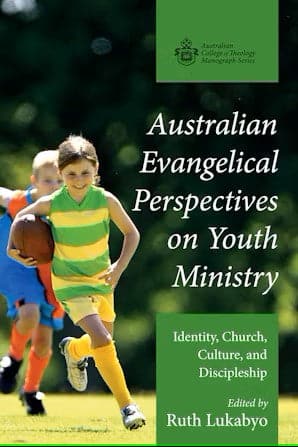
Australian Evangelical Perspectives on Youth Ministry: Identity, Church, Culture, and Discipleship
Ruth Lukabyo (Editor)
Australian Evangelical Perspectives on Youth Ministry: Identity, Church, Culture, and Discipleship
Ruth Lukabyo (Editor)
This book is a unique contribution to the study of children’s and youth ministry, displaying the rich theological thinking that is developing amongst Australian evangelical scholars. You will be challenged to reconsider how theology and exegetical study of the Bible can mould your priorities, principles, and presumptions as you exercise ministry to and with young people.
A Discussion Partner
This book will not plan your program for you, but it will do the leg work of pulling together essays on issues relating to gospel ministry with young people in the Australian context. As “perspectives” in the title suggests, these essays are not held up as the final, or only, word, but act as immensely helpful discussion partners. This book champions that how our churches equip and grow our ministry workers matters. Ministry to young people is not merely a set of skills to acquire, but a ministry that benefits from deep theological engagement.
Anglican Youthworks has been flying this flag for some years with their annual House Conference. This book is a compilation of many of those conference papers and is divided into four areas: identity, church, culture, and discipleship. Some of the topics it considers are age-specific ministries, congregational and intergenerational ministry and cultural perceptions of adolescence. Each writer models and encourages critical engagement with some of the subterranean (or even presenting) questions of ministry to young people without being needlessly prescriptive of what this could look like in practice.
The essays don’t assume the size or structure of your ministry, so are useful whether your group size is three or 300. What is assumed is that age-specific discipleship ministries will take place in churches, not because they are the only or primary place, but because there is great value in churches faithfully and intentionally working with young people. While parents are not the intended audience, per se, these papers can also be accessible to them as they consider their own vital role in discipling their children.
An Australian or Sydney Perspective?
Although written as an Australian evangelical perspective, the book is largely dominated by Sydney authorship, with limited denominational input outside the Anglican church (Timothy Paul Jones excepted on both counts). Although this does not diminish the book’s usefulness, it does speak to two things.
Firstly, it highlights the unique situation of authors within the Australian church scene. Circumstances (social, historical, theological) have meant a geographical concentration of engaged thinkers. This doesn’t happen without intention or God’s kindness, and it is a source of blessing, joy and service to the wider Australian body. However, the concentrated richness of the Sydney ministry community is not always indicative of the context many ministry workers find themselves in around the nation.
Secondly, it emphasises how vital it is to develop leaders and thinkers across the country. The faithful and intentional discipling of young people in Australia is the responsibility of churches and families everywhere. Future editions should speak to the nationwide value and experience of ministry to young people.
Nevertheless, Australian Evangelical Perspectives on Youth Ministry is a rich resource that helps us all to prepare well and continue to share the good news of Christ to another generation who desperately needs him. It is a valuable addition to any library, and a timely prompt to critically consider how young people are discipled in Australia, and beyond.