



Carl Trueman’s short volume Classical Theology for the Modern Mind, from the series New Studies in Classical Theology, aims to recentre Protestants on the classical understanding of God and so give him rightly expressed praise [1]. Divine impassibility, immutability, the equality of the persons, and the eternal generation of the Son are four doctrines that contemporary Protestants are called to recalibrate themselves to so that we do not fall into new versions of old heresies.
What Is Our Heritage?
Trueman presents ‘classical theologians’ as the heritage of the Reformation pioneers. This strongly implies that the truly Reformed will anchor themselves in classical theology. This pastoral appeal to Christian leaders is thus a primer to theological retrieval [2].
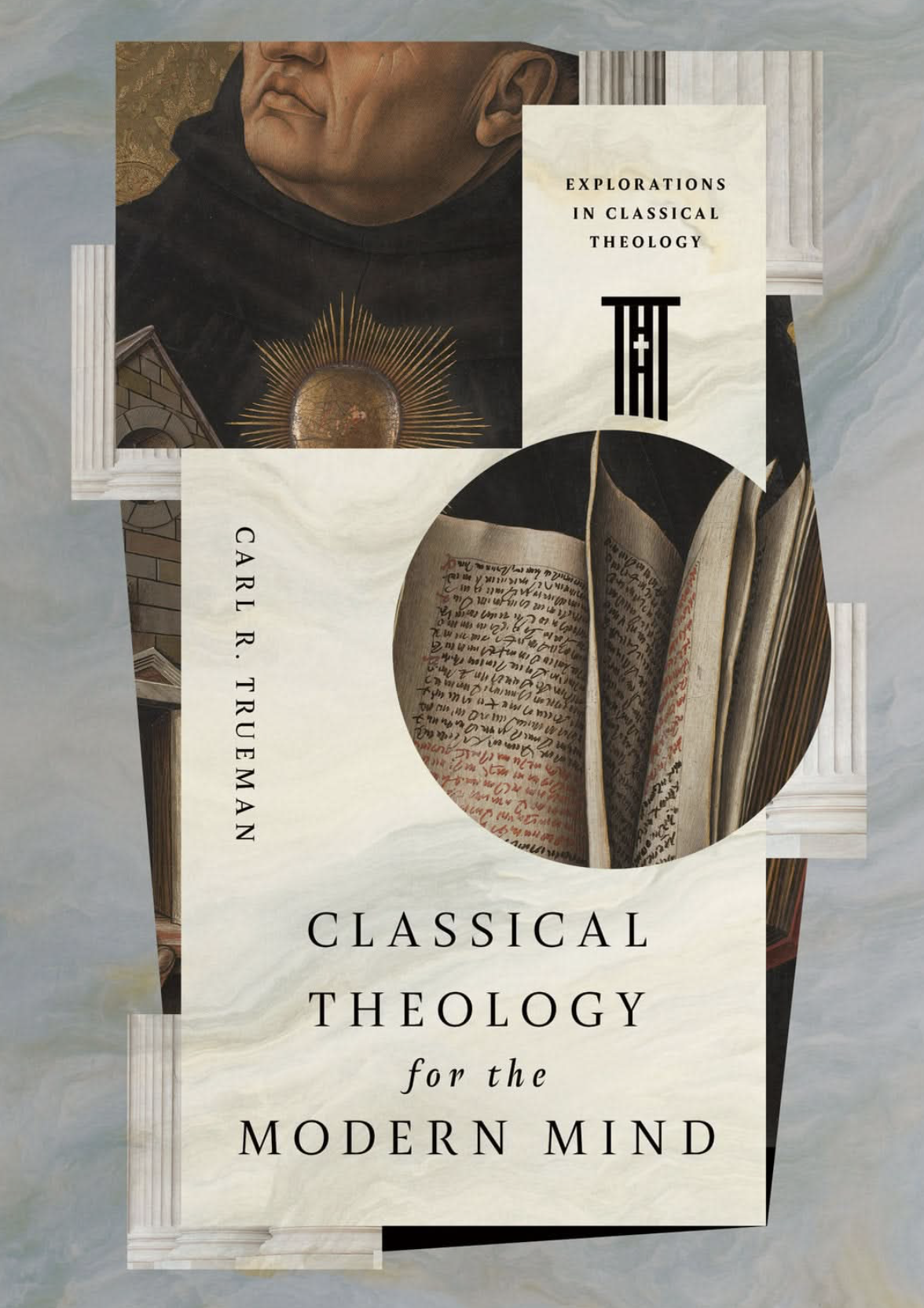
Classical Theology for the Modern Mind
Carl Trueman
In Classical Theology for the Modern Mind, historical scholar Carl Trueman examines how remembering history, reciting creeds, and studying ecclesiology counter cultural pathologies that inhibit our modern minds. By retrieving wisdom, orthodoxy, and historic texts from the church fathers, medieval scholastics, and the Protestant reformers, the church will be better equipped to contemplate God and listen humbly to his word. Based on the Center for Classical Theology’s annual lecture, Trueman has expanded his thoughts for pastors, students, and anyone interested in theology, culture, and the effects of our modern age.
While conveniently written at a time when some young people are taking a path into Eastern Orthodoxy and Roman Catholicism, this is not Trueman’s primary motivation for writing. He instead counsels “well overdue” (p. 2) rootedness in classical theology to counter the pragmatism pervasive in Western cultures and the Western church [3]. Younger Orthodox and Catholic converts are perhaps reacting against this pragmatism [4]. Their reaction creates a different malady, however [5]. Bible-honouring rootedness is the antidote to the chaos in much of contemporary Protestantism.
The Malady and the Cure
Trueman begins by diagnosing the malady in contemporary Protestantism as an appropriation of “the general cultural disposition that disparages the importance of history as a source of positive wisdom” (p. 4) [6]. Biblical interpretation and theological reasoning is done without reference to historic theology. Trueman warns readers that “the Reformers’ Scripture principle should not be confused with a bare biblicism”, as shown by the Reformer’s own reading of Scripture alongside the work of historic theologians (p. 6). Confusion can even begin with theological terms being poorly defined compared to historic defintions (p. 7).
So-called ‘Moral Therapeutic Deism’ continues to be a prominent problem for modern Western Christianity according to Trueman. God is not your therapist. He is the great God beyond us who condescended in his Son for the redemption of the world. To those influenced by such deism, the Psalms and reverent pietistic tradition is very unusual.
What is the cure to this malady? “Classical theology’s first preoccupation was God as God” (p. 11), not mere therapeutic fix. The main contention of Classical Theology is that
all these considerations should press us to recover the classical theology that expressed gospel truths so well. In doing so, not only will we have better theology, but we should also have better worship and devotion, both corporate and individual. (p.12)
I agree. Trueman places the drive for a historically grounded faith and expression of that same faith in the right place: God himself. The wrong driver for any historic grounding of faith and expression would be the tradition-seeking fad that news and online discourse would have us believe is increasingly hoovering up young people. But fads fade. God doesn’t.
Structure
Chapter one eruditely describes the connection between Reformation Protestantism and the theology of the early church:
All the great magisterial Reformers were engaged in a constructive dialogue with and appropriation of the theological past that sought to respect its insights and apply them to the church in their own day. (p. 14)
The Reformers leant on Augustine in particular. Luther saw his debates with Roman bishops through the lens of the earlier debates between Augustine and the Pelagians. Scripture remained the “norming norm”, but earlier churchmen were appropriated to aid understanding (and further justification for the Reformers’ interpretation) of that norming norm.
The necessity of faithful and historically rooted confessionalism, as found in ‘Nicene’ Christianity, is outlined in chapter two [7]. Trueman helpfully points out that “confessional material provides the normative framework for retrieval” (p. 35). Creeds are the guardrails as I walk among the bookshelves of classical theologians. Scripture is the norming norm and creeds are the “normed norm” (p. 40). In other words, Scripture normalises, and creeds express what is thus normal.
Chapter three lays some groundwork for inter-denominational and inter-church partnership, based on the classical doctrine of God. First, we must have a common doctrine of God found in the Scriptures and supported by the creeds: “Scripture is the noetic (thinking) foundation, the revealed source of theology. God is the ontic (related) foundation, the one who reveals himself” (p. 41). He notes that current debates around eternal functional subordination and eternal generation are actually major disagreements which warrant separation between some churches (p. 42):
Today simply gesturing toward the doctrines of salvation as a means of defining unity and the parameters of interchurch engagement can have credibility for Protestants only if it is on the basis of a clear and prior classical Trinitarianism. (p. 43)
Classical theology is applied to pastoral concerns in chapter four. The confusion wrought by Moltmann and his passible suffering God is tackled. A suffering God who lacks the sovereign power to deal with suffering and evil with finality is not a God who can meet our need. Trueman quotes J. Todd Billings:
In the hospital, I didn’t need just solidarity in my suffering. I needed to know that God’s covenant love is so steady and powerful that, in Christ, suffering and death lose their dominion over my life. This God does not need suffering and death in order to be God; instead, in the love that accords perfectly with his covenantal promises, God becomes incarnate as the Pioneer, our Brother, the great High Priest who in his humanity is able to “sympathize with our weaknesses” (Heb. 4:15). This is not a “deep division in God himself.” This is steadfast, trustworthy love. (pp. 50–1)
Chapter five gives pointers for true worship in the light of classical theology. Worship is understood as life and practice rightly ordered under and for God, practiced within, among, and for the church. Indeed, “God is the subject and content of the best worship” (p. 57–8). The Magisterial Reformers are exemplars of this approach [8].
In Need of a Layperson’s Recommended Reading Guide
Picking which classical Christian theologian to read is like walking into Koorong looking for a good Bible study. Then there is the challenge of procuring approachable yet faithful English translations of their work. It would have been very helpful if this book had provided a layman’s guide to top classical works, with suggested translations. Trueman does, however, mention historic theologians worth reading throughout. While the primary point of the text is to convince readers in principle to read classical theologians and hold on to classical theology, such a list would ensure that readers can readily (and safely!) put Trueman’s exhortation into practice.
Trueman predominantly critiques mainstream contemporary American evangelicalism: Moral Therapeutic Deism and the idea of a “God at our beck and call” is in his firing line (p. 59). While these may not be major tendencies in the teaching of Reformed evangelicals in Australia, it remains a cultural influence on pastors and their congregations, whether subtly or substantially. Regardless of the risk of this particular malady, Trueman rightly urges ministry workers to call our people to rightly contemplate our great and glorious God who is wholly other yet wholly for us.
[1] Classical Theology is based on Trueman’s lecture given at the Center for Classical Theology.
[2] For a slightly deeper dive into theological retrieval, Gavin Ortlund’s Theological Retrieval for Evangelicals: Why We Need Our Past to Have a Future is a must read.
[3] Trueman references the shift among some young people to churches with historic forms of worship services (notably Anglican Church of North America), especially among many of his Grove City College students. But this and like phenomena are thankfully never presented as the reason for retrieval. Retrieval and historic forms of worship services ‘because the young people want it’ would just be another kind of pragmatism, just like that which has wrought havoc in much of the contemporary church.
[4] Marco of Across the Pews is a Melbourne-based example of the Protestant to Roman Catholic shift among some young people.
[5] I recommend Allan Chapple’s True Devotion: In Search of Authentic Spirituality to the younger person looking for a grounded relationship with God.
[6] So also, in wider Western culture(s), Trueman questions whether adherents of critical theories (“pathologies”, he calls them) have read the foundational texts of the Frankfurt School, gender theory, or critical race theory. He is right. Critical theories are mediated to students by lecturers and course textbooks. In my experience of liberal arts, he is mostly correct. For many others, they are mediated by online media. Thus we can end up with the discipleship challenge of the Frankfurt School coming to Church.
[7] Trueman leans particularly on the Nicene Creed as an early, universal, and defining standard of the faith throughout Classical Theology. While I agree that creeds are good guardrails, they have their limitations because they are not God-breathed out words. The Nicene, Apostles, and Athanasian (quicumque volt) creeds are good words which reflect the scriptural testimony and are worth reciting, remembering, and affirming, but they are not God-breathed out words. Ultimately scripture, mediated to us by the Spirit, is the transformative authority for faith and life.
[8] The Magisterial Reformers are the major Reformation figures who worked with civil governments to formalise the Protestant Reformation in the sixteenth century, including but not limited to Calvin, Knox, and Cranmer.