





The Gospel After Christendom edited by Collin Hansen, Skyler Flowers, and Ivan Mesa is an earnest call to know the gospel and this cultural moment in the West so that the gospel can be meaningfully applied to people who inhabit this cultural moment. The book comprises incisive contributions from The Gospel Coalition USA’s Keller Center for Cultural Apologetics that will equip readers with the frameworks they need to compellingly practise and proclaim the gospel for the salvation of others and the glory of Jesus.[1]. The authors argue that cultural apologetics is the best framework for gospelling in the secular West. While the authors differ somewhat in their terms and methodologies, together they build an argument for good culturally relevant evangelism.
This is not a timeless work—some of the analogies and historical commentary will not be as poignant in a few decades—but I don’t think it is trying to be. This work is like a library of booklets, equipping ministry practitioners to gospel in this cultural moment. Culture changes like shifting shadows, so our cultural apologetic will shift as we present the timeless, true, and glorious gospel to culture-bound people.
Part one defines the work of cultural apologetics; part two outlines how cultural apologetics is practiced; part three explains how cultural apologetics shows that the gospel is good, beautiful, and true; and part four provides a vision for the church and relationships as the primary arenas where cultural apologetics is employed.
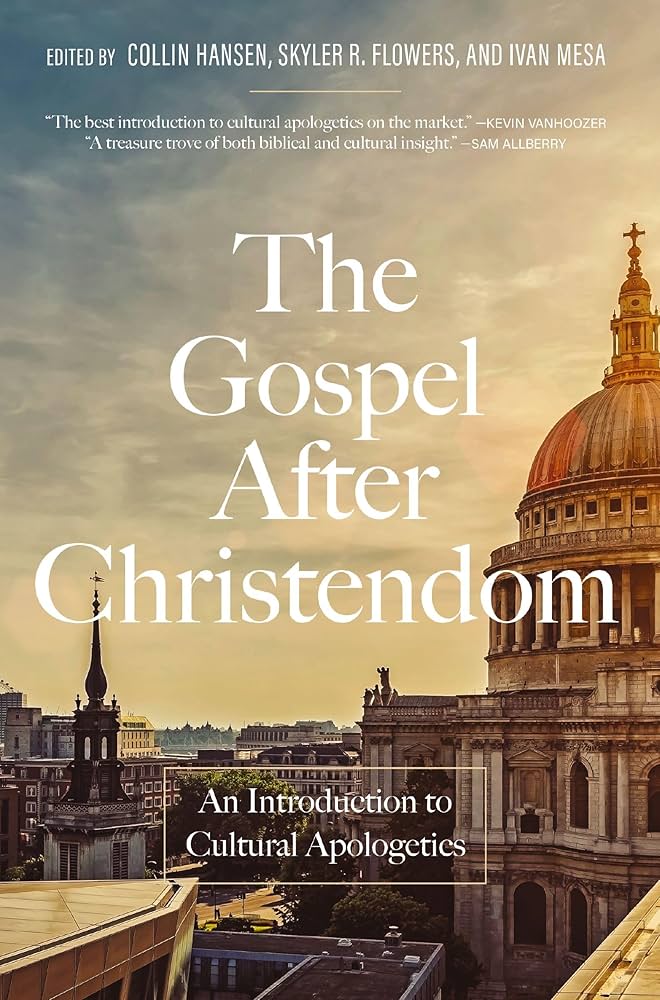
The Gospel After Christendom
Collin Hansen, Skylar Flowers, and Ivan Mesa (eds.)
Purchase from WanderingThe Gospel After Christendom
Collin Hansen, Skylar Flowers, and Ivan Mesa (eds.)
What Is Cultural Apologetics?
Collin Hansen defines cultural apologetics as connecting to “vital sources of biblical, theological, and historical wisdom so we can share and apply the gospel in compelling ways for our secular age” (p. 1). Missiologist Lesslie Newbigin is pointed to as a seminal influence for this approach.
According to Trevin Wax, the task of cultural apologetics is to show Christianity is comprehensible, commendable, and compelling. There is, therefore, a negative and positive aspect to this. The cultural apologist shows how the culture is empty and then how the gospel fulfils people’s deepest needs (p. 18). Wax discusses how this strategy relates to ‘intuitional religion’ (p. 21)[2]. This discussion would have benefitted from further expansion, as those identifying as ‘spiritual but not religious’ are a growing cohort in Western census data. Wax concludes with an important caveat that people do believe the gospel because of cultural apologetics but because of the “Spirit’s awakening” (p. 29). Nevertheless, Christopher Watkin calls on people to “try the bible on for size. You may well find, perhaps to your surprise, that it fits like a glove.”(p. 42).
How Does One Do Cultural Apologetics?
In his chapter, Joshua Chattraw quotes Tim Keller: “Apologetics is automatically contextualisation” (p. 44). While Chatraw sees contextualisation as important, he has concerns about the term cultural apologetics. The risk he sees is that some apologists may think they are doing non-cultural apologetics, while cultural apologists may unmoor themselves from historical and scientific apologetics. Although the label is new, the underpinning ideas are old: “Cultural apologetics should be seen as an apologetic retrieval rather than a novel invention” (pp. 45, 56).
In our cultural apologetics, we ought to have a posture of grace, not condemnation, writes Alan Noble, desiring the repentance of our interlocutors, knowing that God’s kindness leads to repentance (pp. 67, 70, citing Rom 2:4). To that end, we enter their worldview, explore it, expose it, and evangelise, as Daniel Strange outlines the process (p. 81). N. Gray Sutanto urges us to be attentive to “the heart’s influence on the way we reason” (p. 88) and Gavin Ortlund encourages us to explain to non-Christians how unliveable, meaningless, and disenchanting unbelief is (Chapter 7).
What Answers Does Cultural Apologetics Give?
Rebeca McLaughlin, Rachel Gilson, and Derek Rishmawy demonstrate how the goodness, beauty, and truth of Jesus are the answers cultural apologetics gives to a needy culture. Jesus is good because only he has the words of eternal life (p. 126); the beauty of Jesus is seen in his people; and Jesus is presented as the truth that that is better than individualistic preferences. The dominant christianised culture that the West was known for has splintered into almost individual sub-cultures. But this will not be workable long-term. Individualistic preferences “work for me” until they don’t (p. 140). This malaise is perhaps why so many in the West are struggling with anxiety and loneliness. We are not designed to exist alone.
Where Is the Best Context for Cultural Apologetics?
The church is God’s chosen arena for mission to a needy world. Non-Christians “need to see a community of men and women who believe [the gospel] and live like it” (p. 157). Relationships are core to reaching Westerners (p. 176). Bob Thune says that the church can show how the life of the gospel is better and truer than the life of the culture by engaging doubt, welcoming the outsider, rejoicing in repentance and faith, and embodying resilient hope. As Collin Hansen says in the introduction, good cultural apologetics starts with spiritual renewal in the church: “The world sees Jesus in how the body of Christ lives together with grace, in truth, for love” (p. 5). We don’t create this contagious community primarily to trigger a sense of ‘I want what they’ve got.’ The attractiveness of Christian community is a side-effect of us being Christians in community.
The Diversity of Western Cultures
While this volume contains some recognition of the many cultures that are represented in Western countries, this reality could have been commented in much more depth. Western countries are not characterised by a monolithic culture; subcultures are perhaps more dominant than national cultures, and there are nation-to-nation differences.
‘The culture’ is also primarily understood by the contributors as secular. That might be more true in America, where dechristianisation is still taking hold, but the rest of the West is post-secular—spiritual but not religious[3]. The landscape in Australia is different enough to the US for some Australia-specific cultural apologetics. I think that intuitional religion is probably where the West is headed. This will look a little like cultural Christianity among some and not (most) others.
The Gospel After Christendom is thought-provoking and will challenge your ministry practice, from evangelism to discipleship to preaching. While I did not universally agree with every author or think that the understanding of the West presented in much of this book is universally true within the West, this work will give you a starter pack for understanding how to read this cultural moment and apply the gospel to it so that the gospel can be understood as good, beautiful, true, and believable—so that people might believe.
[1] The book opens with substantial praise for Tim Keller. The introduction ends with the prayer, “may his tribe increase”. I deeply appreciate how God used Keller and there is much to learn from his life and ministry, but the most important tribe to belong to is Jesus’ tribe. I felt the celebration risked centring our attention and appreciation on Keller’s ministry philosophy rather than on Jesus. Thankfully, the other chapters move on from this emphasis on Keller in name, if not in terms of his enormous influence.
[2] Intuitional religion is essentially DIY religion. The idea refers to spiritual beliefs which person may intuit from their own experiences or inner life. Personal perception and feeling are emphasised over historic and formalised religions.
[3] Recent data from Pew shows that Christian self-identification in the US has shown a marginal uptick. However, I suspect that the Trump phenomenon truncates what lies behind the numbers.
Geoff Smith et al, Decline of Christianity in the U.S. Has Slowed, May Have Levelled Off, Pew Research Center, 26 February 2025, https://www.pewresearch.org/religion/2025/02/26/decline-of-christianity-in-the-us-has-slowed-may-have-leveled-off/, accessed 29/10/2025.