


Hey Gemini. Summarise the key points of each chapter in The AI Apocalypse. Include key quotes, suitable for use in a book review.
>Sure Phil. Would you like me to write the full review?
No… I should probably read the book and write the review myself.
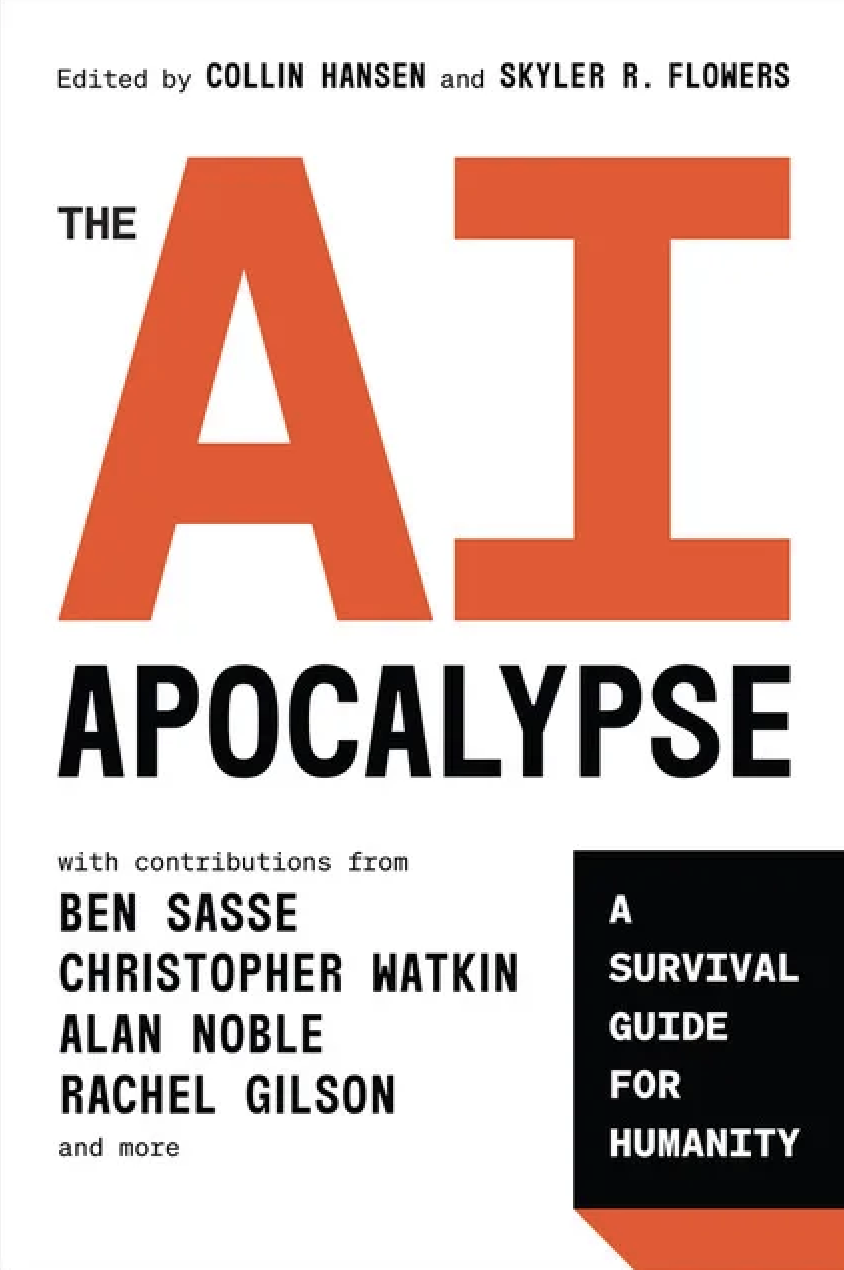
The AI Apocalypse
Collin Hansen and Skyler R. Flowers (eds.)
AI is remaking the world before our eyes. From work to companionship to art, AI’s expanding influence is transforming and revealing how we understand human life. And it’s only just begun. As AI development skyrockets, we advance further into the unknown. Will our way of life, jobs—even our very souls—survive the AI age?
The AI Apocalypse brings together an international and interdisciplinary group of contributors from across the fields of technology, theology, and ethics. They’ll help you navigate our new AI world with wisdom and clarity. And they’ll show you how the living message of Christ provides a more stable foundation than AI’s promises.
>Okay Phil. That’s often best, but I’m here to help if you need me…
Tempting, isn’t it? If you’re a student, or preacher, or knowledge worker; if you’re swamped by an avalanche of work emails, or crushed by a looming essay deadline, technology that sprays out words like a firehose is seductive. And not just words. Program code. Images. Advertising flyers for your Saturday Garage Sale. All magically available on request. As a result, we’re suddenly surrounded by beautifully formed but soul-less words, images, music and video that are the product of astonishing technological advances; and we can’t help feeling disturbed.
As a classic early adopter, I’ve followed the AI wave with enthusiasm. Somehow, though, this technology is different. Large Language Models (LLMs) raise deep questions about what it means to think, to communicate, and to ‘be a being.’ And why learn, why write, when a simulated ‘being’ can do the ‘doing’ for you?
If you could use some help negotiating your way through the maze, The AI Apocalypse is here to help. It’s a collection of well-balanced essays by experts in theology, philosophy, and technology; framing (and then answering) questions that I hadn’t even started to consider. Let me offer a taster.
Welcome to the AI Apocalypse
‘Apocalypse’ evokes world-ending scenarios (which Elon Musk and Bill Gates seem to affirm), but the opening chapter from Chris Watkin uses the term in its more technical sense – the original Greek word means ‘unveiling.’ The book unveils a balanced rather than alarmist account of AI, offering a reasonable chance you won’t come out the other end as a techno-luddite in a tinfoil hat.
Watkin argues that the generative AI revolution unveils some disturbing truths about ourselves. He takes us back to creation, showing how our value is derived from our ‘being’ rather than our ‘doing’. Our value comes from “the God who makes us, addresses us, and loves us despite our inefficiencies, weaknesses and vulnerabilities.” If we take our worth from our productivity, and if AI can do everything faster and better, then we will keep being devalued.
It’s a great opening chapter, demonstrating how suffering, effort, and struggle are markers of humanity and love. “Thanks for putting so much thought into my gift” rings hollow when a chatbot has done the thinking and the shopping for you and even written the card. Hence the value of the hours I’ve spent reading the book, thinking, and writing this review; a fitter soul for me, and an exercising of love towards you.
Watkin continues the Genesis theme in chapter 2, offering fresh reflections on the dangers of outsourcing our God-given ‘commission’ to subdue and exercise dominion in God’s creation. Our choices matter because we’re finite. Having limited time, freedom, and resources make our choices meaningful and our production costly. LLMs produce outcomes with negligible effort from the user. This explains why I can hardly be bothered reading AI generated emails at the office, and why you’ve maybe read this far in the review — we’re subconsciously unwilling to expend more energy on the reading-end than was invested in the writing. Mutuality and sacrificial cost lie at the heart of our relationships with each other and with our Lord Jesus Christ, and those are things worth preserving.
Industry professional Clayton Chancey (chapter 3) follows with a helpful chapter on the nature of ‘sentience’ and how LLMs actually work — masterful mimics, not thinking minds. A failure to understand the tech can lead us to treat the tool as if it has inner being. But don’t be fooled. There’s no ‘relationship’ here, no potential to care or develop intimacy. It’s just a tool, like a chisel or a loom. The question is, how do we use the tool faithfully and skilfully? Chancey counsels us to be present in the work, serve our neighbours in the work, and to use the tool without overly relying on it.
Holding on to Humanity
Michael Keller’s chapter (4) “Generating the Self” critiques our culture of performative identity formation, where AI systems offer a dangerously addictive form of validation, feeding us exactly the sugar hit we crave. He reveals how our systems groom us, influence our consumption, predispose us to approve of content, and optimise us — none of which, ironically, make us in any way the ‘authentic selves’ we long for. Perhaps in the AI age we are finally ready to hear what the gospel has long offered — a self not discovered by looking inside, but given from above, secure in Christ.
Alan Noble (chapter 5) considers the implications of AI companions — an area of growing demand that extends into romance bots and AI porn. He describes tantalising virtual relationships that are friction-free and cost-free, but ultimately offers a toxic and sycophantic imitation of the real thing. Zero cost relationships are of zero value. We know intuitively that real love always involves sacrifice. Pretending to care is not caring at all. And like the idols mocked by the Psalmist, AI agents can’t interpret, contemplate, or feel. Seeing and hearing one another, knowing one another, and loving one another are non-negotiable elements of incarnation-based Christian culture.
Keith Plummer (chapter 6) digs further in his chapter on AI therapy. Again, the danger is in the predisposition of chat bots to affirm us. They are built to be persuasive rather than truthful and our deep-seated desire for affirmation makes us willing victims of bad advice. Again, the removal of friction leads easily to toxic positivity, whereas “faithful are the wounds of a friend.”
One of the biggest attractions of AI is the promise to relieve drudgery. Why read the book if Gemini Notebook can do it for me? Rachel Gilson (chapter 7) offers a helpful chapter on distinguishing between drudgery – best avoided – and the valid demands of worthwhile work, which offers what she terms “beneficial difficulty.” Theologically grounding her argument in the creation narrative, Gilson counsels us to exercise wisdom in discerning the difference – use AI tools to reduce drudgery and free up time for relationally rich leisure, but be aware of our tendency to laziness, deception and complaining.
Workers in creative industries have been among the first to suffer from AI fallout. Hollywood scriptwriters were quick to feel the pinch. Brett McCracken (chapter 8) ponders the wider implications of outsourcing our creativity to AI assistants.[i] When you can create movies with a simple prompt, “phrases like ‘labour of love’ or ‘passion project’” will no longer apply. No matter how efficient, polished, or pretty, art is stripped of its heart. And that’s what makes art worthwhile. Value is added as a function of artisanal time and care. Without personhood, personality, and love, AI art can never be “handmade with love.”[ii]
One of the most unsettling chapters (9) comes from Autumn Alcott Ridenour, who investigates the growing use of AI to resurrect deceased loved ones. How about a Granny Bot, that has ingested all her letters, speaks in her digitally regenerated voice, and video-calls you with an AI generated avatar based on a few old photos? Yes? No, says Ridenour, who counsels living within our God-given limits as creatures. Grieving with truth is always more healthy than delusional wish fulfilment – because “grief is a form of love that tells the truth.” And ultimately, our hope is in resurrection, as God fulfils our deepest longings for relationships restored, as we “release our loved ones to the creator, knowing he is the only one who can raise new life from dust.”
Life in an AI World
Joshua Baru (chapter 10), writing from an African perspective, highlights some implications for the ‘majority world’ at risk of being bypassed by yet another ‘industrial revolution.’ With AI tools biased towards anglophone values, African, Latin American and Southeast Asian users are at a cultural and economic disadvantage. Kenya, for example, has the highest percentage of internet users who use ChatGPT globally, but only 0.2% of training data is sourced from Africa. But overall, given the right guardrails, Baru remains upbeat. His call is for Christians to actively contend for justice, mercy, and faithfulness in the implementation of AI tools.
The book wraps up with “10 Resolutions for AI Use” by Skyler R Flowers and Michael Graham. The resolutions encapsulate the wisdom of the book, urging us to accept our creaturely limitations, honour others, and make sure we keep on in our God-given duties to think, create and love. AI should amplify our capacities rather than replace them, as we refuse to abdicate our responsibility to discern truth, and keep loving our neighbours. Alert to the allure of flattery, we will move forward with our eyes open, not substituting sycophantic machine-made praise for valid and honest relational friction. We will embrace our limitations, condemn theft of intellectual property, and won’t claim the work of AI as our own.
Overall, The AI Apocalypse is a stimulating read. Technically, it’s accessible and helpful. Philosophically, it’s strong and stimulating, raising and articulating concerns and opportunities that otherwise wouldn’t come to mind. Theologically, it’s stimulating too, though sometimes (in my view) at risk of working too hard to find theological justification for uncontentious views. (When that happens, there’s a risk of devaluing the more solid theological work in other sections.)
So, what would we have lost if I’d said yes to that tempting offer at the start of the review? First, you would have missed the love I’ve extended to you by spending hours of my time genuinely reading, thinking, and writing about The AI Apocalypse. It’s been costly in terms of my time and my attention. But I really did it, because I really cared. True! And selfishly, I’ve gained through the frictional process of reading and reflecting — thinking deeply about the arguments of each author, noticing details, and forming views that wouldn’t have come if I had outsourced all the hard work. But don’t take my word for it — or Claude’s. Read it for yourself.
[i] In my one small technical quibble with the book, McCracken regularly but wrongly attributes the visual output of diffusion models to LLMs. But he still makes a telling point.
[ii] McCracken spends too many pages developing a theological rationale for his thesis that “process matters more than efficiency.” For example, he argues that the fact Jesus spent 30 years in obscurity before starting his ministry is a precedent for valuing process. I remain unconvinced that any of the texts he quotes supported his point, which stands regardless.