






“Whose daughter are you?” This is the first question I am asked when I attend an event in the Sri Lankan Tamil Christian community. Not my name, but my parents’ names. The question may be even more direct: “Are you so-and-so’s daughter?” In fact, someone may walk away from a conversation with me without ever knowing my name.
Though it can sometimes feel like it, it’s not a lack of social skills that triggers this question. In Tamil culture, knowing whose daughter (or son) you are is important. Social introductions amongst Sri Lankans sound a bit like a genealogy you might find in the Old or New Testament. Your genealogy places you within a community and reveals where you’ve come from, who shaped you and often what your values are. When I respond with my parents’ names, recognition dawns on my interrogator’s face and we have bypassed minutes of small talk. They proceed to tell me in detail how they might be connected to me, whether by village, by blood or by marriage. Culturally, family heritage plays a significant role in who you are and making these connections is highly valued. Being known as my parents’ daughter gives me assurance and a place in this community.
Remember, You Are a Child of God
What would it be like if I more fully appreciated the even greater assurance of my place in God’s family? Would I walk into rooms with more confidence, knowing that I am a dearly loved child of God? After all, being my parents’ daughter gives me a place of belonging in this life, but being God’s child gives me an eternal place in his kingdom. This truth not only brings comfort but should also shape how I speak, act, and carry myself each day. Imagine if I held that identity at the forefront of my mind; how much more boldly and joyfully would I live, remembering exactly whose I am.
Being a child of God changes our identity. Romans 8:14 tells us that we are children of God, able to call him Father by the work of his Spirit. 1 John describes the great love the Father has lavished upon us for us that we have become his children. What great joy and confidence: we are children chosen by the almighty God. My mum’s parting words to me are often, “Remember, you are a child of God.” She uses this phrase quite broadly to capture many truths: to remind me of my identity and value in Christ, that I can take joy in bold steps in faith, and that there is nothing to fear with God in control. When we face challenges, we face them knowing that we are children of God and our heavenly Father is with us. Being a child of God means we can move forward boldly and joyfully.
This is the reminder I need when I find myself in conversations at work and realise that I alone hold a differing opinion or value to everyone else. I have natural tendency to feel ashamed for being the odd one out, but knowing that I am a child of God is an encouragement. I am not on my own, God my Father is with me. Even in Christian circles, my insecurities can make me feel out of place or unworthy, especially when I fall back to defining my own identity and value apart from God.
The Pride and Responsibility of Being a Daughter
Our identity informs our outward appearance and manner. In Tamil gatherings, once my identity is confirmed, I’m observed carefully for resemblance—in my face, my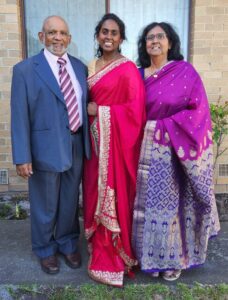 mannerisms, my speech, or eve my character. I have been compared to my parents, my cousins, my auntie, my grandfather’s younger sister. It is both a sense of pride and of responsibility that I experience in these moments. I am pleased when I hear that I am like my mum and dad, but I also know that I need to be on my best behaviour to represent them well.
Similarly, our lives are a reflection of our heavenly Father and we are called to live in a way that reflects our identity as children of God. In Ephesians 5:1–2, Paul’s commands that “as dearly loved children,” we are to follow God’s example and walk in the way of love. In Matthew 5:14–16, Jesus’ says we should let our light shine before others so that they “may see your good deeds and glorify your Father in heaven.” Am I aware of who is watching me, recognising me as a child of God, and wondering how my behaviour and attitudes reflects my Father?
I have faced the reality of this mixed blessing at work, when colleagues have noticed and commented on the behaviour of myself or other Christians. I have been encouraged when colleagues have told me they value a trait in me and credit it to me being a Christian. On the flipside, I feel the weight of hearing colleagues tell me “Shouldn’t you not do that because you’re a Christian?” People are watching to see how much we resemble our Father; it’s both a joy and a challenge.
What if, in every social situation, it was not just our name or our job that people remembered, but the unmistakable mark of us being children of God? How can our words, attitudes, and actions make it clear that we are children of a loving Father? Ultimately, the question “Whose daughter are you?” is not just a cultural curiosity, it’s about identity, belonging, and purpose. For those of us who follow Christ, it is a question that calls us to live visibly, boldly, and joyfully as children of God.