



In “Wise AI” Daniel Sih and Paul Matthews navigate the tension between fast versus slow and presence versus efficiency in the use of Artificial Intelligence (AI). Through reflection, frameworks and examples they engage carefully so that practitioners can use this powerful technology “in a deeply human way” (p. xviii).
The book is structured in three sections of unequal length. Chapters 1-3 focus on the human condition and the dangers of AI. This technology accelerates life and compounds our tendency to cram more in. Chapters 4-7 define wise AI use which creates room for deep work, deep thought, deep relationships, and deep rest. Chapters 8-13 provide a relevant framework and posture for wise AI engagement, including numerous practical tips.
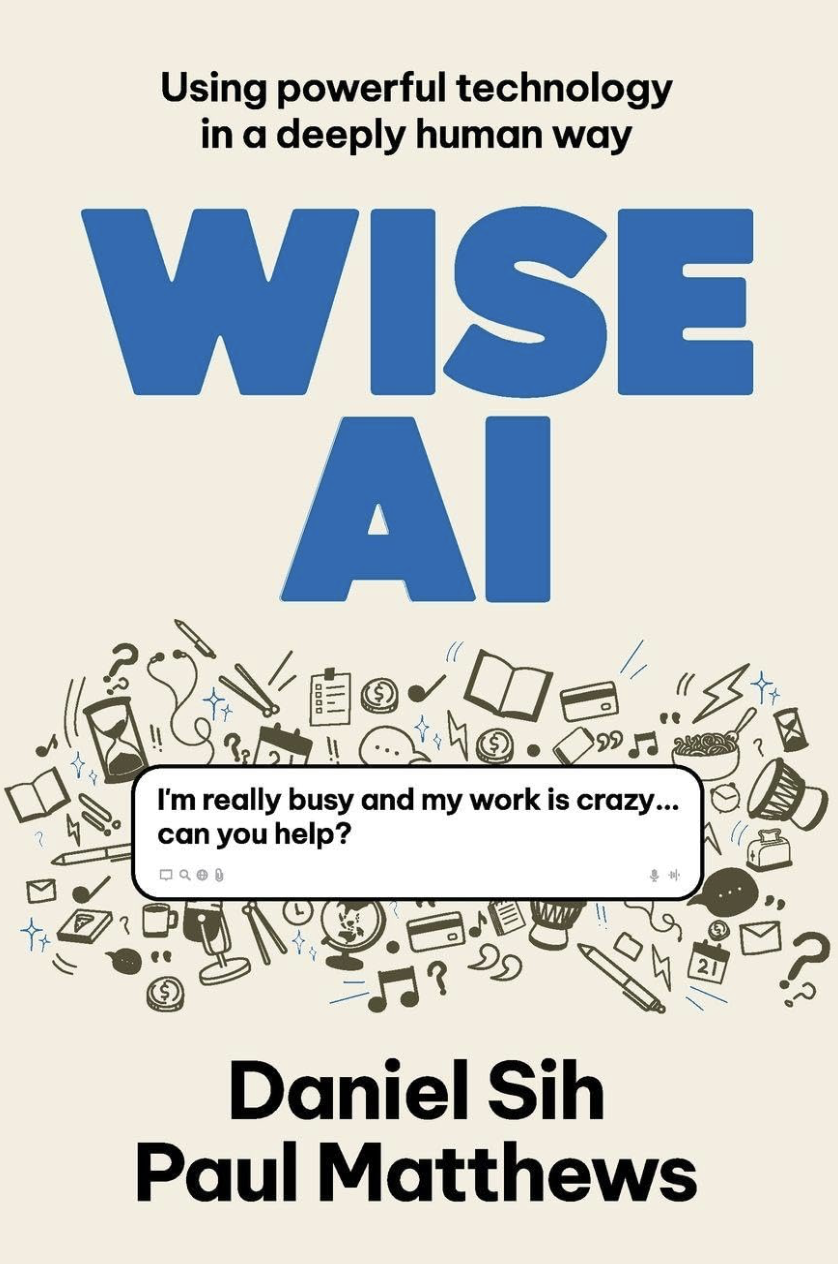
Wise AI: Using Powerful Technology in a Deeply Human Way
Daniel Sih & Paul Matthews
Purchase from AmazonWise AI: Using Powerful Technology in a Deeply Human Way
Daniel Sih & Paul Matthews
AI has redefined how we work, making us faster and more efficient. But for those already stretched thin, life hasn’t slowed down.
The workload keeps growing and we’re struggling to keep up.
Wise AI offers a different path, helping us rethink how to use AI to make space for deep work, deep thought, deep rest, and deep relationships.
Strengths
This readable and engaging book is accessible to a secular audience and useful for Christian ministry. The book focuses on the use of AI rather than the ethics of AI. The authors are realistic about what’s distracting and what’s life-giving. Their stories and tensions are relatable, and their vulnerability and optimism are attractive. The book’s greatest strength is its insistence that wise AI use requires a framework, careful thought, and a clear mindset. “Wise AI begins… not with tools, prompts or productivity gains, but with discernment” (p. 59).
The four rhythms of wise AI draw on Daniel Sih’s Spacemaker (2021). These rhythms are deep work, thought, relationships, and rest. These are winsomely commended to the reader and push-back against frantic, reactive, and the always-doing-more use of AI (pp. 51-77).
Sih and Matthews provide principles for AI use in the LEARN framework are applicable beyond AI use. First we Lean into Learning, “staying undazzled by hype, unparalysed by risk and genuinely effective in a changing world” (p. 91). In Examine Your Why they press into the deeper goals for using AI. They suggest this ought to be “making space – space to live a richer, deeper, and more connected life” (p. 108, emphasis original). This clarity of purpose allows us to Act in Alignment with our goals, “allowing our deeper purpose to guide what we say yes to and what we say no to, and how we choose to work when no one is watching” (p. 117). Under Refine Your Skills, they offer 10 core skills which apply across AI platforms. These are practical and improve accuracy and efficiency. They include such things as effective prompt construction (role/task/format), an iterative rather than one-shot approach, watching carefully for AI bias and verifying output with your own organic intelligence. Finally, the reader is encouraged to Navigate Change “not with panic or pressure, but with steady, grounded movement” (p. 177).
The book’s ecosystem of website, online toolkit and automated follow-up emails makes for ongoing engagement.
Ultimately, the wisdom they promote echoes God’s wisdom of “living well in the world we’re in” (p. 43), gently aware of our humanity’s weaknesses but boldly desiring “to serve others” (p. 84).
Critiques and Questions
The Christian worldview of both authors, though not foregrounded, is evident. While they cite Proverbs 26:4-5 as an example of wisdom’s trickiness, they stop short of Proverbs’ own wisdom foundation: the fear of the Lord.
A repeated mantra is to use AI in a “deeply human way” (p. xviii), not in unthinking reactiveness. But this may be confusing or inaccurately optimistic about our fallen condition. The authors acknowledge our natural tendency to frenetic activity serving the idolatry of achievement but then assume that “deeply human” is all good. To leave God out and rely on an idealised good-natured humanity distorts an authentic self-understanding and obscures the true wisdom that is needed to navigate this dangerously powerful technology.
AI hallucinations continue to plague AI’s use. The authors propose verifying AI with their own “organic intelligence”, but this relies on having expert knowledge in the relevant area. AI use restricted to topics in which one is already familiar will significantly limit the application of AI by users.
The approach to creativity in Wise AI is confusing. The authors acknowledge that creativity is hard and that relying on AI for creativity atrophies our own. Yet they propose (Skill 4 – Tweak by Hand) that AI might generate ideas and we “make the final tweaks by hand… AI can get you to 80% quickly” (pp. 146-147), treating AI “less like a tool and more like… an editor” (p. 181). Even if we retain the final decision, we have outsourced the imagination and therefore have lost creative ownership.
For ministry leaders this high degree of creativity seems short-sighted and dangerous for spiritual formation and integrity. Pastoral, theological and ethical work that involves rightly handling the Bible in ministry to complex people made in God’s image is categorically different to the book’s often-cited cases from the business world. Spirit-led reflection and prayer must be the spring of a pastor’s creative output. The use of our own God-given minds must take a higher and earlier role in spiritual reflection, not just tweaking almost-complete output or evaluating AI-generated options.
Perhaps rather than asking when to step away from AI, wise AI might ask when to step in to use it.
For Secular and Christian Readers
The book is accessible to secular and Christian readers alike, to those fearful of AI or moving too fast, and of course to those seeking wisdom for its use. Ministry practitioners may be frustrated about a truncated definition of wisdom, but they will benefit from the mindset-first approach and the practical examples.
I was left wondering where God fits into Wise AI, and hesitant about the high degree of AI creativity encouraged by the authors. But I appreciated the authors’ humility, vulnerability and real-life situations, the emphasis on establishing a healthy mindset for wise AI use, the useable framework, the practical tips, and worked examples. I commend this book to every thoughtful Christian wanting to engage, under God, reflectively and practically with this increasingly present and powerful technology.