

Few western Christians have a working knowledge of Eastern Orthodoxy. This makes it difficult to understand the worldview and questions of their Orthodox friends and leads to misunderstandings over words and concepts. In A Christian’s Pocket Guide to Eastern Orthodox Theology: An Evangelical Perspective, Panagiotis Kantartzis offers a concise yet deep explanation of the fundamentals of Orthodox doctrine.
The book walks us through core topics such as the mode of theologising, the relationship between Scripture, Tradition, and the Church, the doctrine of sin, the meaning of the cross, deification, and the process of salvation. Each chapter follows a clear pattern of presenting Orthodox teaching using primary sources and theologians, offering an appreciation of its strengths, a critical analysis, then providing an evangelical response.
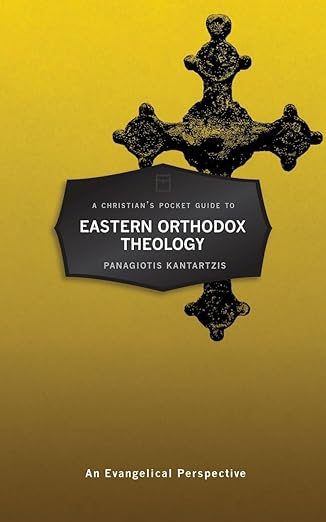
A Christian's Pocket Guide to Eastern Orthodox Theology: An Evangelical Perspective
Panagiotis Kantartzis
Purchase from ReformersA Christian's Pocket Guide to Eastern Orthodox Theology: An Evangelical Perspective
Panagiotis Kantartzis
We may associate a number of images with the Eastern Orthodox church – ornate church buildings, services with candles and incense, men wearing embellished robes – but what does the Eastern Orthodox church actually believe? What are the similarities and differences between them and western evangelical churches? What is their history? In this short book Panagiotis Kantartzis introduces us to Eastern Orthodoxy from an Evangelical perspective and tells us what we need to know.
The Unknowability of God
The starting point of any theology is epistemology. Orthodox doctrine arises from the conviction that God is the creator whom his creatures can neither access nor comprehend. Only by abandoning all that belongs to the created universe can God be approached. Even “knowledge” itself is a created element so cannot describe a holy God. So Orthodoxy can only produce negative assertions about the divine. For instance, “God is good” cannot be affirmed but only that “God is not evil.” This is the discipline of apophatic (negative) theology whereby building one negation upon another, a worshipper might progressively glimpse God.
“Theology does not concern knowledge apprehended by the mind but a participation in the truth, which must be attained through prayer and the liturgical life of the Church” (p. 11). Truth is not primarily transferred as knowledge as much as embraced by experience. The goal of such knowledge of God is not informational, but transformational. This mystical inner journey is the Orthodox way to approach and make oneself spiritually fit for God.
The evangelical response, according to Kantartzis, should be to point to the fact that God communicates by words, not experiences, and personally through his Son. “We speak of God, in other words we theologise, because God first spoke to us” (pp. 13-14). There is a limit to our knowledge of God according to what he has revealed, not according to our apophatic efforts. he aptly cites A.N. Williams who stated,
To say God is unknowable in the face of the divine self-giving that is Scripture is not only to deny what Scripture is —both the record and enactment of divine self-giving— but in that denial, also to fail to receive the gift with joy and thanksgiving (p. 15).
Theosis and the Problem of Sin
God’s unknowability means that humanity’s problem is not a broken relationship with God. Rather our problem is failing to make ourselves spiritually fit to glimpse God. It is a process they call theosis; to become like God is the object of salvation. This is facilitated by participation in “the Church” (meaning Eastern Orthodox) and the sacraments, especially baptism and communion (p. 56).
The problem of sin is then not one how it incurs God’s wrath but instead how it impedes our deification. “God is not a magistrate condemning a guilty party, but a Father disappointed by the behaviour of His immature child” (p. 33).
This leaves no need for Penal Substitutionary Atonement. The emphasis on Jesus is instead on his incarnation and how he models the God-man to whom we are all to aspire. His death in Orthodoxy becomes a kind of Christus Victor: through it he demonstrates his defeat of Satan and death on behalf of his people. Yet even then it is an incomplete atonement for it still relies on our effort to purify ourselves.
In response Kantartzis correctly directs us to the cross. “What must be the nature of our fall and of our sinful condition if the only way to override it, was the death of God’s Son on the cross?” (p. 40; and also Gal 2:21!) He poses the questions that should be directed to our Orthodox friends: “Why did Jesus have to die?” and more pointedly, “Why was Jesus crucified?” Jesus knew the cursed death he would undergo, he insisted it was necessary and that it was for the ransom for many. It is by acknowledging this that our Orthodox friends will be challenged by the seriousness of sin and additionally the completeness and assurance of the salvation of Christ’s people.
Kantartzis has packed even more of value in this brief treatment for those of us seeking Gospel conversations with our Orthodox friends. Firstly, it’s a concise yet comprehensive summary of Orthodox doctrine making it much easier for Western Christians to comprehend. Secondly, Kantartzis identifies foundational Orthodox doctrines supported by Scripture, which can be used as starting points of agreement for evangelism. Thirdly, Kantartzis gives us ideas of where to take our friends as he raises the Biblical alternatives to many doctrines.
I would recommend this book for anyone with a theological background who wants to get greater understanding and depth in Orthodox theology. Pocket Guide will clarify Orthodoxy for converts who tend to be better read than those born into it.
However, I think the main benefit is for our understanding of Orthodox doctrine, rather than to fuel our Gospel conversations. The risk of confronting Orthodox people with the flaws in Orthodox doctrine is that defensiveness will be the most likely result. My preference is to challenge Orthodox people with the Gospel. This book will help us with common starting points as well as understanding subsequent questions and objections.