




Early in my Christian life, I was discipled in a church that emphasised emotions about all else—big worship, loud prayer, visible passion. My quiet times focused on my gut reaction to Scripture, often detached from context or authorial intent. My sense of my spiritual health rose and fell with how I felt, rather than with God’s unchanging character and promises. My faith felt like an emotional rollercoaster. Now, in a Reformed evangelical context, I often experience the opposite. My quiet times can become all about mind and will—what the text means and what I should do—while neglecting conscience and passions. All head and hands. Very little heart. But God commands us to love him with our whole hearts.
What Does the Bible Mean by “Heart”?
In the Bible, the heart is far more than emotions and feelings. It refers to the centre of the person’s inner life. In the Old Testament, the heart includes the mind, will, conscience, understanding and passions. Pharaoh’s heart is hardened, leading to stubborn resistance to God (Ex 7:3). The Israelites’ hearts melt in fear after the spies’ report, resulting in disobedience and forty years in the wilderness (Deut 1:28). The LORD’s commands are to be on their hearts, shaping how they think and live (Deut 6:4–6), and it’s the hearts of Israel that turns away in idolatry (Deut 29:18). When God chooses David, he makes the standard unmistakable: “People look at the outward appearance, but the LORD looks at the heart” (1 Sam 16:7).
Crucially, God also promises that the heart itself will be changed under the new covenant:
I will give them an undivided heart and put a new spirit in them; I will remove from them their heart of stone and give them a heart of flesh. (Ezekiel 11:19–20; see also 36:24–28)
Moses anticipates this in Deuteronomy:
The LORD your God will circumcise your hearts and the hearts of your descendants, so that you may love him with all your heart and with all your soul, and live. (Deuteronomy 30:6; see also Romans 2:29–30)
In the New Testament also, the heart is the centre of a person’s existence—one’s thinking, choosing and feeling. Peter’s hearers are “cut to the heart” as their consciences are pierced (Acts 2:37). Paul says Israel’s hearts are veiled, preventing them from seeing the glory of Christ (2 Cor 3:15; 4:4). Paul prays for the Ephesian church that the eyes of their hearts would be enlightened (Eph 1:18). Later in the same letter, he prays for Christ to dwell in his readers’ hearts through faith (Eph 3:16–17).
The Faculties of the Heart
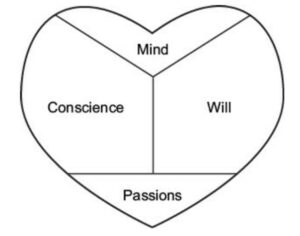
In The Heart Is the Target, Murray Capill helpfully describes the heart as having four faculties: mind, conscience, will and passions. The mind is what I know and believe, including about God’s character, will and purposes. The conscience is “The smoke alarm of the heart”;[1] God’s truth either accuses or reassures me, forming conviction. The will is where decisions are made—how I choose to live in response to God’s truth. The passions are my loves and desires, what captures my deepest affections and delight.
Capill writes for preachers, but this insight also relates to our daily Bible reading and prayer. Our quiet times struggle when we consistently neglect faculties of the heart.
Questions to Focus Our Quiet Times
Here are some questions I’ve been using to engage each faculty of the heart. You don’t need to ask all of them every day; try choosing one from each category, or coming up with your own. Then write a biblically rich prayer that touches each area, not just thinking about God but meeting with him.
- Mind: What is the main teaching of the passage? What do I learn about God, his character and his promises? What do I learn about myself and the world?
- Passions: What stirs my love for and delight in God in this passage? What can I thank and praise him for? What rival loves might be competing for my heart?
- Conscience: What confronts or convicts me here? What sin do I need to confess? Do I feel the appropriate weight of my sin? How does the gospel speak into this area, reminding me of forgiveness and freedom in Christ?
- Will: What does obedience look like in response? Where do I need to trust God more deeply? How does the grace of God teach me to say “no” to ungodliness and “yes” to Christlikeness?
You might have noticed that I’ve put passions after mind, rather than at the end. This isn’t a mistake. I’ve noticed when I respond to the Bible’s teaching with thanking, praising and delighting in God, then my heart is truly stirred. He graciously replaces my old passions and pleasures with new ones. I’m drawn to love him above all else. Confession and obedience are more natural and heartfelt coming after this reorientation of my passions.
Our daily time in Bible reading and prayer is a means God uses to gradually reshape our hearts. By his Spirit, through his word he graciously transforms our wills, brings light to our minds, renews our consciences and draws us away from worldly desires to a passion for God and what he loves. He replaces our divided hearts with undivided ones. As our hearts are transformed, our quiet times begin, not perfectly, but genuinely, to “work”, because they are doing what they were always meant to do: helping us to love God with our whole heart.
This article was originally posted on Jo’s Substack.
[1] Murray Capill, The Heart is the Target (2014: P & R Publishing), p. 106.